Developer / Publisher – Fast Travel Games Price – US $29.99 / EU €29.99 / UK £24.99 Release Date – March 20th, 2018 Input – Tracked Motion Controllers Play Area – Sitting, Standing, Roomscale Store – Steam Reviewed on – Oculus Rift
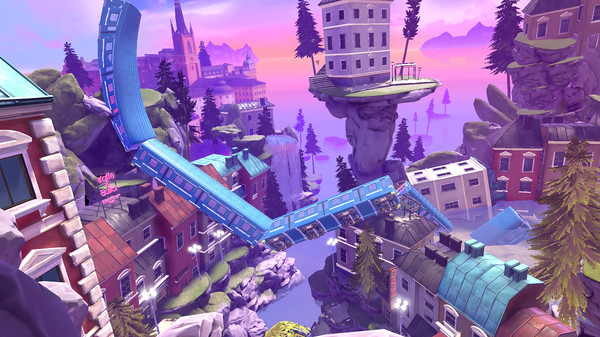
Walking through the apocalyptic yet colorful settings in Apex Construct I was struck by how much care and detail went in to the making of this world. A fully fleshed out story had me looking in every crevice and search every room to make sure I didn’t miss any small nugget of information I could get my hands on. The desire to push forward is very present, and the nagging suspicion you are about to face danger never lets you linger in an area for too long.
It’s a crazy mixed up place!
In Apex Construct, you are the last human tasked with figuring out what is happening around you and possibly save the planet from whatever happened to it in the first place. Aided by an AI who clearly has many of the answers you seek, but keeps it to himself, it doesn’t take too long before you begin question his motives. You are constantly hunted by Mothr (yes, I spelled that right), another AI who wants to kill you and destroy any chance at humanity returning to the earth. In this regard, Apex Construct has vibes of Portal and System Shock, developing the AI enemy very well and keeping them menacing throughout the game. The story has twists and turns, and plays out to a satisfying conclusion. Apex Construct is a slow burn, so people looking for non-stop action all the time should look elsewhere, but don’t let that turn you off, this game is very polished.
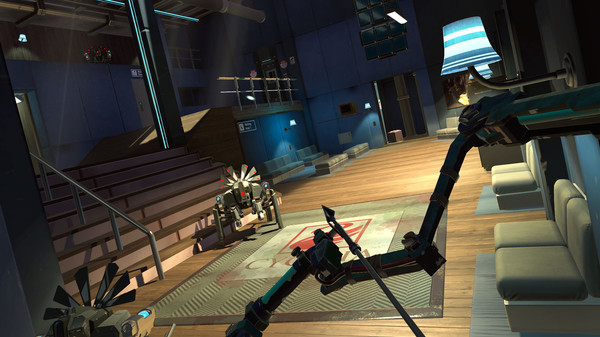
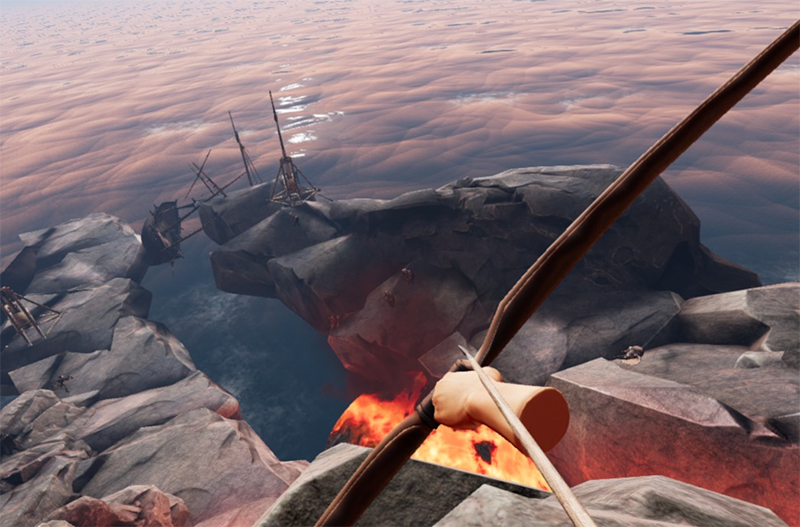
Gameplay wise, you travel through the world either via teleport, or free locomotion using trackpad/thumbstick. Expect to enter codes in computers, search for hidden items and buttons, and encounter enemies who you must destroy with your only weapon, a fancy looking bow. The archery in this game is excellent, and I would easily put it on par with The Lab. There is no hand holding here so you need to learn to aim. It isn’t too difficult however, and you will soon be switching between your different types of arrow with ease and killing enemies left and right. Your bow can also switch to a shield which is vital in tough battles when the enemy is trying to take you out, though it can only take a few hits.
You are going to see these spiders a lot!
With different types of arrows and items to carry, you are going to need an inventory sysytem. Simple, holographic screens appear out of your hand when a button is pressed and store any items you have picked up. To take them out or equip them you just grab the item and pull it out of the inventory. It’s super simple and keeps from breaking the immersion in game. Back at your home base, where you choose the next mission or any of the previous ones, there is also an upgrade station where you can spend RP, the games pseudo currency dropped after dispatching enemies or hidden around each stage, to give allow you to take more damage to shoot more powerful arrows.
The visuals are wonderful. Enemies look stunning yet simple, though there are only a handful of different enemy types, and the world around you is decaying at just the right rate to be derelict yet beautiful. The effects that take place when you shoot different arrow types look good. There is a less cartoony Borderlands feeling going on, but one that fits the world and the action well. The audio is great too. Music swells when you complete the goal of the current level, and when the music changes up, you know to expect and incoming battle.
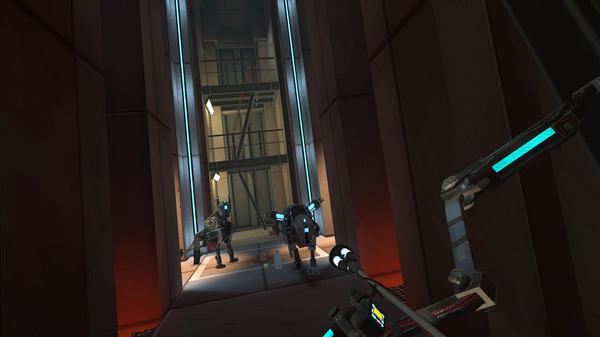
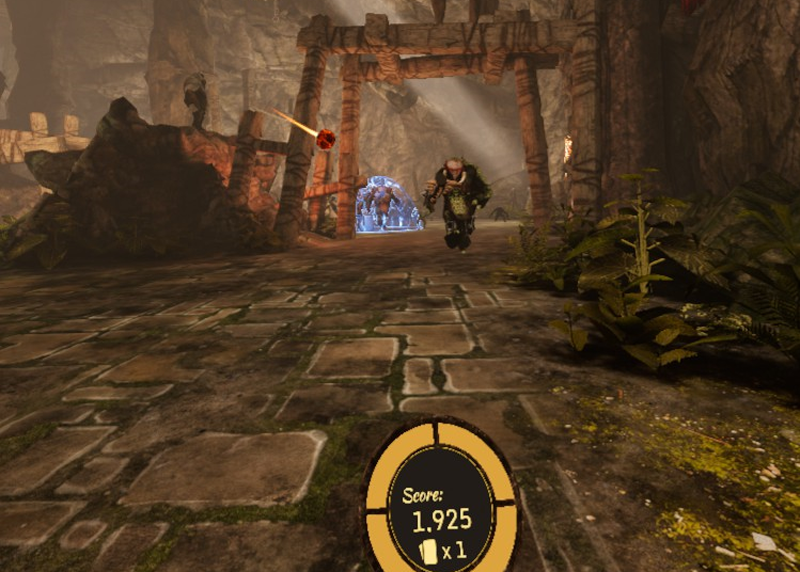
These dog are very quick so you better not miss!
Overall Apex Construct is a game I think everyone who is a VR lover should play. The bow work is tight, the graphics are polished, and the story kept me wanting more.
What would I pay? I would happily pay $15-20 for Apex Construct. The 4-5 hour long campaign has replayability, and going through the first time I had a blast. My only real complaint is that in between objectives I would have liked to see a little more movement in the world. Everything is so still, which is fitting, but a little off putting.
Fast Travel Games provided The VR Grid with a review code for this title and, regardless of this review, we thank them for that!
Developer / Publisher – Korte Games Price – US $14.99 / EU €14.99 / UK £10.99 Release Date – August 30th, 2017 Input – Tracked Motion Controllers Play Area – Room Scale Store – Steam Reviewed on – HTC Vive
Infinity Fall is a sci-fi themed, single player VR shooter that takes place entirely in zero gravity, an excellent and unique gameplay mechanic that fits perfectly into VR. Unfortunately, it falls flat in most other aspects. This game uses an excellent six-dimensional gimmick, but this doesn’t redeem its many flaws.
In Infinity Fall, the player must fight through a space station to escape “Dave,” the starship’s rogue AI central computer. In addition to wiping out the ship’s crew, Dave disabled its gravity. As a result, the player must traverse the terrain by gliding through the air. The game uses a “grip” system, similar to that in “Climbey,” to allow this type of locomotion. You can grab any wall with your hands, allowing you to move however you want. You’re able to grab a wall with alternating hands to climb it like a rock wall, or a ladder. Alternatively, you can launch yourself off surfaces at high speeds, pushing off walls like the side of a swimming pool. These actions are all physics-based, with faster movement speeds the harder you fling yourself. This locomotion system feels perfect for VR and generally works well in Infinity Fall, granting freedom of movement.
In zero gravity, dead enemies don’t float around much more aimlessly than you do
While the locomotion system in Infinity Fall is fun and unique, it results in secondhand issues that severely hinder the experience. When swinging yourself along a surface, letting go of the trackpad even a fraction of a second too late causes you to lose all momentum, awkwardly freezing in mid-air. Because of this, navigating large environments in zero gravity can be irritating at best, and infuriating at worst. When losing velocity in mid-air, you’ll need to find a new surface to launch yourself off of. In wide-open rooms, there won’t always be surfaces nearby. This results in several agonizing minutes of free-floating, at the pace of a drunken snail, until you reach a new surface.
Being stuck in mid-air is even more frustrating with enemies nearby. This game is very difficult, killing you at a moment’s notice if you aren’t quick on your feet. The challenge in Infinity Fall is actually fun and fair but contradicts the game’s movement system. This game requires fast-paced movement to survive, so being unfairly slowed down results in an unavoidable death. In unlucky situations, you might find yourself frozen in mid-air, with no surfaces within reach. When this happens, crashing the game and restarting from scratch is usually the only solution.
When you finally find a surface to grab, make sure you don’t accidentally hit something in your room. The locomotion system in Infinity Fall requires you physically reach for the closest grabbable surface, making this game even more liable for bedroom-destruction than “Gorn.” For the same reason, this game is unexpectedly physically active and exhausting. While I usually appreciate VR games that yield a workout, physical activity in Infinity Fall is based entirely on your movement. Some well-performed leaps can fling you all the way to the other side of the room, while some maneuvers will send you slowly drifting in the wrong direction. Just keeping yourself under control requires strenuous exercise, even though the game’s movement system doesn’t actually demand it. When I break a sweat as a result of in-game movement patterns that I didn’t even want to do, such exercise just becomes an annoyance.
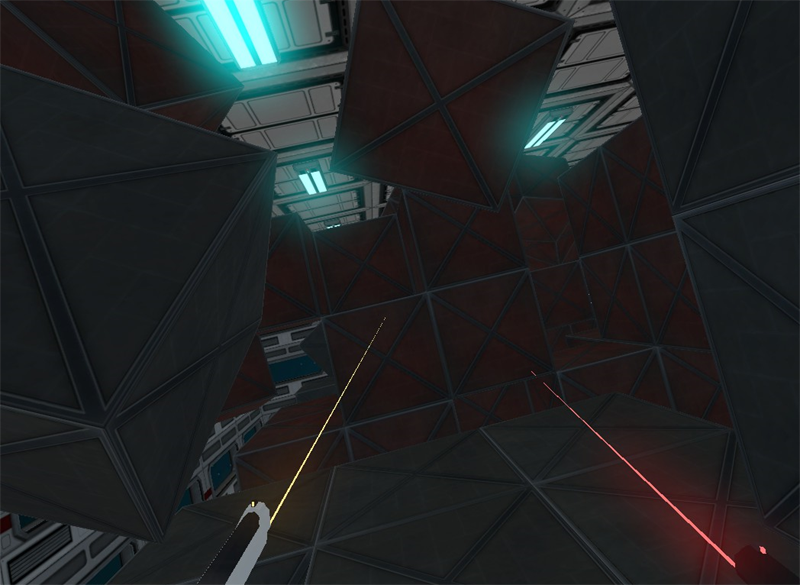
The game’s biggest challenge involves searching boxes for a keycard, which is as exciting as it sounds
Many of these locomotion-related issues are a result of Infinity Fall’s weakest aspect: its environment and graphical design. Every room takes one of two forms: expansive mazes of oversized ventilation shafts, and wide-open arenas with floating boxes. Mazes are easy to maneuver, with grabbable surfaces always within reach. However, their design is repetitive and boring. It’s easy to get lost during maze sequences, and while this is to be expected, such map structure worsens the earlier exercise-related issue. When I’m rapidly waving my arms to float in circles around a maze, it quickly stops feeling worth the effort. Large rooms are much more straightforward, but they’re much more prone to leaving you slowly floating in mid-air, with nothing to grab. As I touched on earlier, these moments can be frustrating enough to warrant a rage quit.
Throughout Infinity Fall, the environments themselves never seem to change much other than their basic shape. Everything is composed of identical, monotonous colors and textures. I got bored of the game ten minutes in, just because its environments are so drab and repetitive. Infinity Fall seems to be a beginner-level Unity engine project, and it shows. Textures look grainy and smudgy, while lighting remains constant throughout the game. The visuals look like that of an early-2000’s browser game, and the repetitive 90’s techno music follows the same theme.
One of Infinity Fall’s biggest design flaws is its visual assets. All it took was a quick Google search of “Unity asset robot” to reveal that nearly everything in Infinity Fall– from enemies, to weaponry- is taken directly from the asset store, copy-and-pasted, with little changed other than their colors.
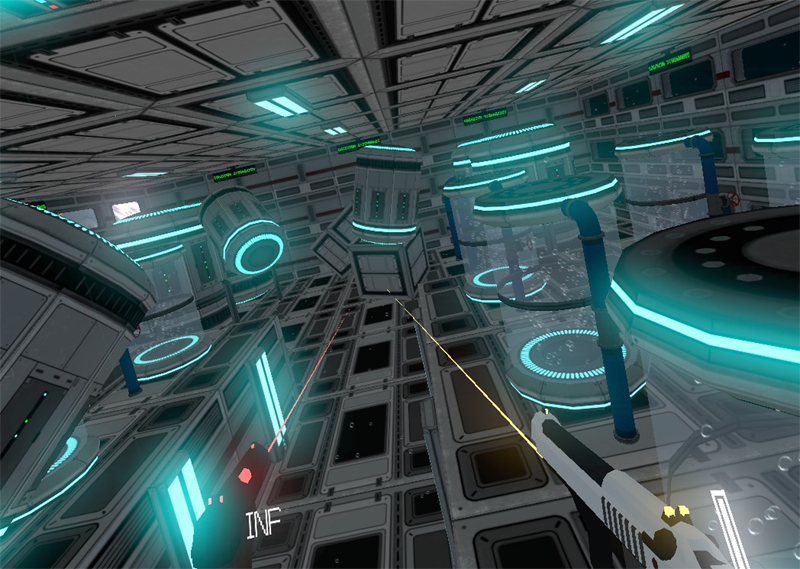
This is arguably the game’s most well-designed room, which doesn’t bode well for its other rooms
Throughout the game, you’re given four weapons, though these mostly feel like increasingly advanced copies of one another. While Infinity Fall is unabashedly a sci-fi game, the gun models used are modern or even World War 2-era handguns that shoot lasers. With the exception of one rapid-fire glock pistol, each gun differentiates only in its color and damage output.
Enemy design isn’t much more creative. Most opponents are drones, which are difficult to hit but die in one shot. There are humanoid robots that are easy to target but have higher damage and health than drones. Throughout most of the game, these are the only enemies. There are also mini-bosses, which feel generic and serve as little more than a chore. In contrast, the game’s final boss was well-designed and a fun challenge.
Infinity Fall is broken up into six test chambers, each with slightly different objectives. Some pit you against enemies or bosses, some require you find a keycard, and some serve as time trials. Infinity Fall is one of very few VR first-person shooters that are structured in a coherent, linear, campaign format. For what it’s worth, this game is certainly not a generic wave shooter. Still, most levels feel cliché and boring.
Any tests not involving combat feel like filler for the game’s content value. Finding keys feels like a forced scavenger hunt, while time trials are easy and repetitive. The game took just over an hour for me to beat, with a lot of that time spent frustratedly drifting around due to the aforementioned locomotion issues. By the time I completed Infinity Fall, I felt like I’d only just finished a free demo or beta for the game. Considering its price, I was shocked by the game’s abrupt ending and meager length.
It feels like the developer couldn’t decide whether or not to add a story to Infinity Fall. The game’s antagonist, Dave, communicates with you via scrolling text on monitors throughout the map. Dave’s emoji-filled speech feels unplanned and overly casual. Reading these screens, the player is clearly meant to feel intimidated by Dave’s evil ways. Rather, I just felt like the developer was having a one-sided text conversation with me. These screens account for nearly all of the game’s story elements, giving you little insight into the narrative. The one exception is a single wall of text that appears after you complete the game, detailing the events that follow. Ironically, this final page depicts a clever, interesting story, which was largely devoid from the game itself. The story seems to be a spin-off of Stanley Kubrick’s “2001: A Space Odyssey,” but Infinity Fall does no justice to the classic film. The narrative isn’t bad per se but was evidently added as an unprofessional afterthought. To my surprise, at least the post-ending credits sequence is cool.
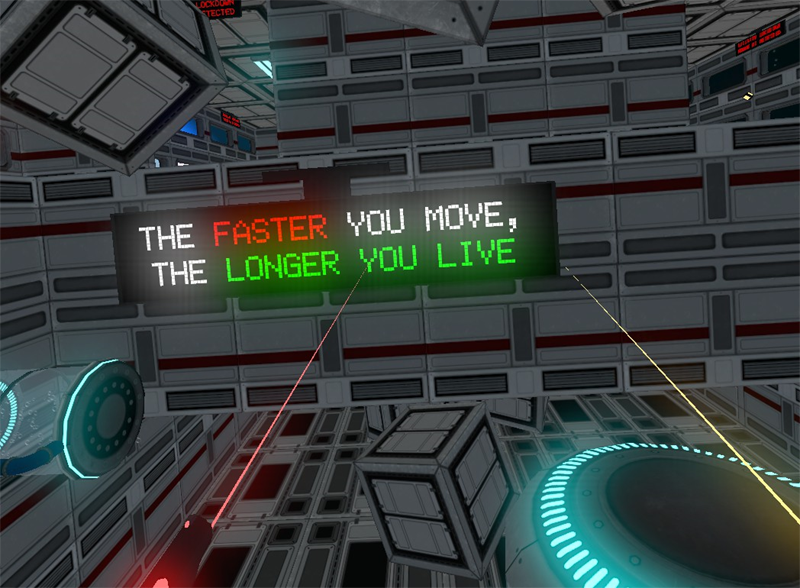
Is this a suggestion, or a warning? Is this a tutorial hint, or is Dave taunting me? Who knows?
The game’s user interface isn’t very good either. While dying in-game spawns you at the latest checkpoint, you can’t save the game and quit. The main menu’s “continue game” button doesn’t work, so you must beat the whole game in one go, or risk losing your progress. Infinity Fall also hosts a totally unnecessary backpack system, which is meant for holding key-cards and guns. Being forced to manually swipe cards to unlock doors already feels arbitrary, as most games with keys integrate them as passive items that you never need to access. There’s also no reason that you shouldn’t be able to switch guns using a controller button, rather than having to open and manage your inventory. The inventory system is fairly simple, but completely obsolete. With absolutely no benefit to gameplay, it adds confusion while removing immersion.
What would I pay for it? I would not pay anything for Infinity Fall. If its weapons, enemies, interface, and environment were all improved, it might be worth $5-10 because of its fun and unique zero-gravity movement system. As it stands, however, this game feels like a lost cause. Everything about it is frustrating and dull. For roughly an hour of substandard gameplay, Infinity Fall’s asking price of $15 is not worth paying, regardless of your interest in the game.
Korte Games provided The VR Grid with a review code for this title and, regardless of this review, we thank them for that!
Developer / Publisher – Samurai Punk
Price – US $19.99 / EU €19.99 / UK £15.99 / AU $24.95
Release date – March 13th, 2018
Control Method – 2 x Move controllers
Pro Patch – No
Digital only – Yes
Reviewed on – PS4 Pro
I have no idea what the ideal American dream is and I definitely don’t think what’s being offered here would have even crossed my mind as an ideal fantasy world I’d like to live in. Without delving too deep into gun issues and having limited knowledge of all the happenings and legalities in America as of late, as a Canadian, it seems like a decent portion of America REALLY likes there guns. The American Dream is made by an group based out of Australia and I feel like they are exposed to the same type of media that I am with regards to guns in America and have made a game that parodies, pokes fun at, and crticizes our views on firearms today.
As a child, this iis how I remember my 1st meal!
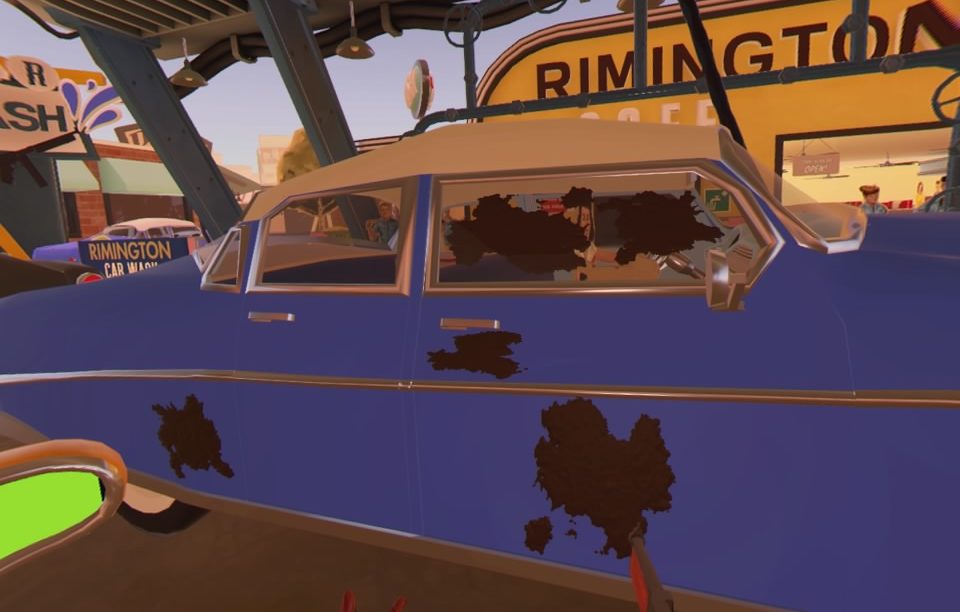
Suprise, suprise, it’s Move controllers only as you fire at a very wide variety of targets with your dual pistols or a rifle. A push of the trigger is all you need though I found aiming down the sites to be a tad tricky. As you progress through the campaign, more scenario specific weapons are given to you, like a sniper rifle, machine gun or a few other modern day firearms. Each scenario requires you to (mostly) shoot designated targets to complete a task. These range from sniping the cardboard cut-out of girl you like, shooting the mud off off cars at a car wash, or just shooting the dinner bell to summon a waiter. Non-shooting elements include stuff like a dance, gathering cotton candy or feeding a baby with the muzzle of your gun. It’s all very silly but tracks really well and shooting does feel quite good. Bullets leave a trace-line so those who just fire from the hip can adjust accordingly if their previous shots missed the mark.
The American Dream takes you through life, from being a new born all the way to adulthood, and picks important moments for you to play through. As a baby, which is also the tutorial stage, you must shoot a door to get your mothers attention whereupon you must eat food off of the end of the gun. Playing catch with dear ol’ dad? When he tosses a ball your way, you need to shoot it in mid-air to send it back to him. This plays like a carnival ride where you are strapped inside a bumper car and are driven, on rails, to each new stage. Once you have expended your ammo, or release the clip, buttons on either side of the cart light up and pressing said buttons launches a new clip in the air and time slows down so you slide the new clip into your gun in one, smooth, John Woo style motion. I loved the slow-mo mechanic as it made me feel like a badass every time I did it.
The best way to clean a car has always been with an automatic rifle!
The American Dream has seen fit to go back to a simpler time, the 1950’s, and while the world around you is ‘real’ enough, the cardboard cut-outs that populate it hammer home that you in a very surreal ride. Whether it be on the job, at the fair, or the school dance, the stand-ups with mounted speakers play out each scenario is a very dry, comedic fashion. On your journey the Mascot for the American Rifle Assosication, a dog named Buddy Washington, is at each stage and explains each scenario in glorious 50’s style PSA fashion akin to the same type of videos seen in the Fallout series of games, and commentates throughout each scene. It’s very dry humor but works wonderfully within the sarcastic nature of the game and I found myself laughing out loud on more than a few occasions.
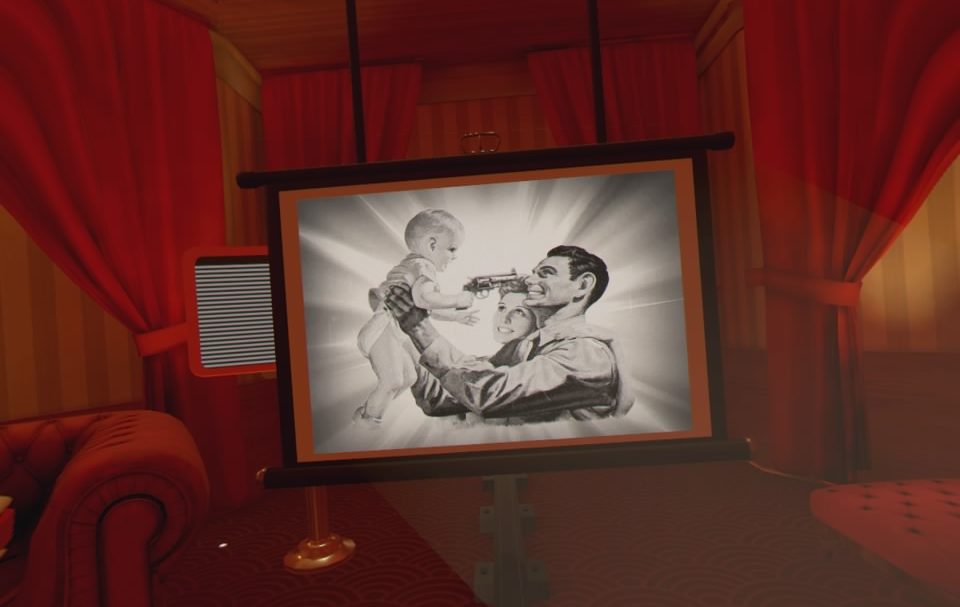
The main theme of the game, imo, is in this picture
This is not a typical shooter by any measure of the genre. Very rarely are you told to just shoot whatever you want and instead must ‘play along’ with what the scenario asks of you. At a romantic dinner for instance, you shoot the menu to choose your dish, are given 3 pistols for your meal instead of spoons, each smaller than the last and those are used to shoot the next course in the meal, you summon the waiter by shooting a dinner bell and the scene ends with you taking out a golden gun and shooting the engagement ring on your gal. Most of the stages play along a similar line requiring you to perform menial tasks that would be incredibly dull save for the fact that they are accomplished by gun play. The American Dream is a very scripted game and I can honestly say I have never played anything quite like it.
Each level also scores you at the end in the form of money($), but as far as I can tell, this is mostly for comedic value as some of the score modifiers included are impossible not to achieve, though it does track your accuracy on certain stages. Additionally, each stage has a star icon or 2 hidden somewhere which I think just gives you an achievement, but it’s something to look out for. The campaign should take close to 4 hours or so and not all the scenarios work as well as others,with some being quite dull. Some tasks get a little mundane and boredom does set in on a few levels, but for the most part, I was entertained.
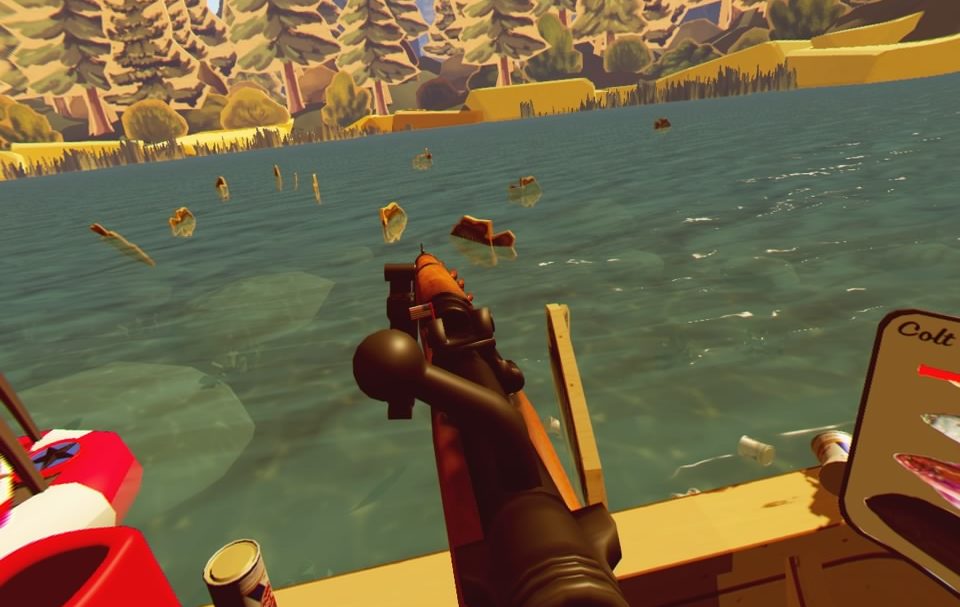
Nothing quite like fishing, South Park style!
The American Dream, at it’s core, is a message about modern gun culture in America. The opening stages are very light-hearted and take a much more comedic approach to gun whackiness. As the you ‘grow-up’ in the game though, darker tones begin to emerge that actually had me a little uneasy. This is a game with a message about just how absurd the love for firearms has become in the USA. It’s poigniant, topical and I think most importantly, will make you think about and maybe question your views on guns. The end of the game was crazy over the top and dragged on way to long, which was obviously no accident as the full brunt of the games theme is hammered home in an unrelenting fashion, though even with that last drawn out sequence, I appreciated what the game was trying to get across to the player. Creating a shooter with a message like this is definitely odd and rarely done for obvious reasons, but in my humble opinion, works great and does what it sets out to do, make you think while keeping you entertained.
What would I pay? I think the $20 is more than fair fr this. It has a fair bit of content for that price and is the one of the more unique games I have ever played in my life. The overall messsage is pretty serious, but the sarcastic way it is presented makes this more fun than preachy.
Developer / Publisher – Handy Games Price – US $9.99 / EU €9.99 / UK £6.99 Release Date – March 15th, 2017 Input – Tracked Motion Controllers, Gamepad Play Area – Sitting, Standing, Roomscale Store – Steam Reviewed on – Oculus Rift
Panzer Panic VR is a tank shooter game that excels in some basic cartoon tank fighting but fails at both the multiplayer and length.
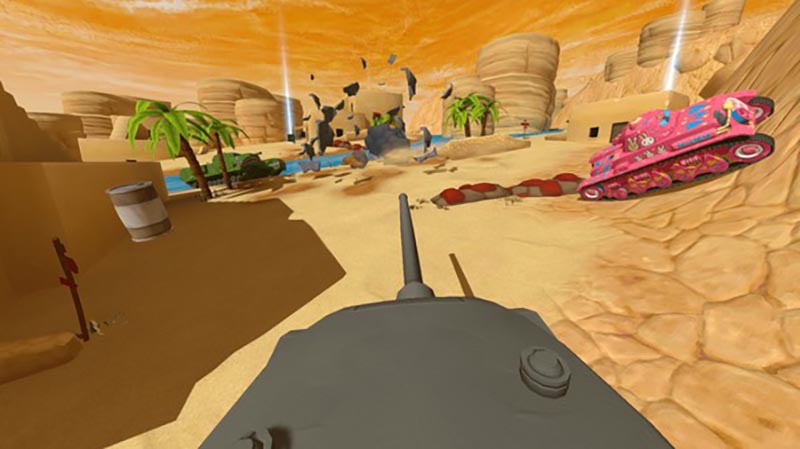
Pretty much the entire game can be captured in this screen shot
Across the few maps in Panzer Panic, the game is very simple, Team Deathmatch or Capture the Flag games go on until one team wins through a points system. Drive around, shoot at enemy tanks, and pick up powerups like speed boost and rapid fire. Unfortunately, the tanks do not control very easily. Playing on Oculus Rift, I often found one of my controls suddenly not responding until I did some button mashing. Thorough testing showed it really was a problem with this game. Being unable to turn my tank at random intervals killed the fun, and watching some other people play the game on YouTube confirmed that I am not the only one with this issue. Hopefully this is something that can be easily fixed in a patch.
Graphically and audio wise the game is a delight. The bright colors feel playful, and the music is quite catchy. I could hear my shots destroying enemies as they exploded into balls of flame, and I really enjoyed unlocking new skins and tanks. The biggest problem here, is that unless you have a friend with a headset and a computer with you for a LAN party, there is no online multiplayer. The lack of online multiplayer means you will be playing against bots who, while enjoyable, do not present any real thrills after a few matches, and are fairly easy to predict after only a little play time.
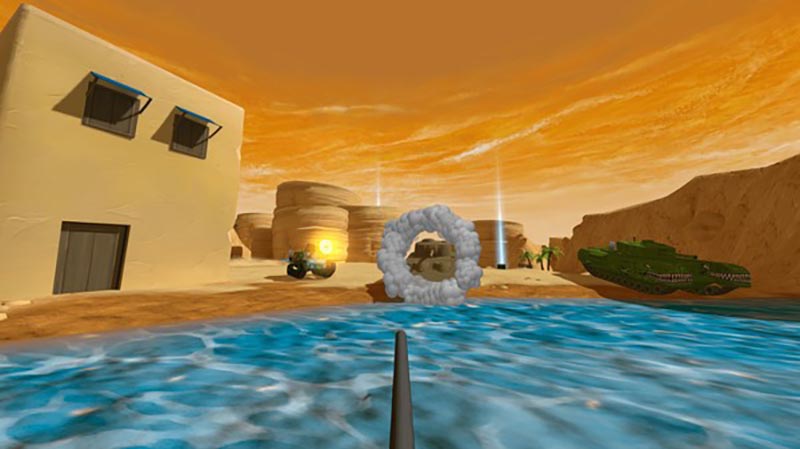
Watch out for that tank!
If you are a big fan of tank games I could see picking this up to have a few hours of fun, but without a friend, the game will soon be put in your backlog and stay there. One of the biggest challenges with VR is multiplayer userbase, but by not including the option, Panzer Panic shoots itself in the tread.
What would I pay? In its current state, lacking in multiplayer, I would only buy this for $3-4.
Developer / Publisher – Turbo Button
Price – US $5.99 / EU €5.99 / UK £4.79 / AU $8.95
Release Date – March 20th, 2018
Control Method – Dual Shock, 2x Move Controllers
Play Type – Seated, Standing, Room-scale
Pro Patch – No
Digital Only – Yes
Reviewed on – PS4 Pro
Floor Plan is a point and click puzzler that is a little more complex than it initially appears. At it’s core this is an escape room type game with the difference being that the rooms around you change, making this feel unique in the ever growing escape genre.
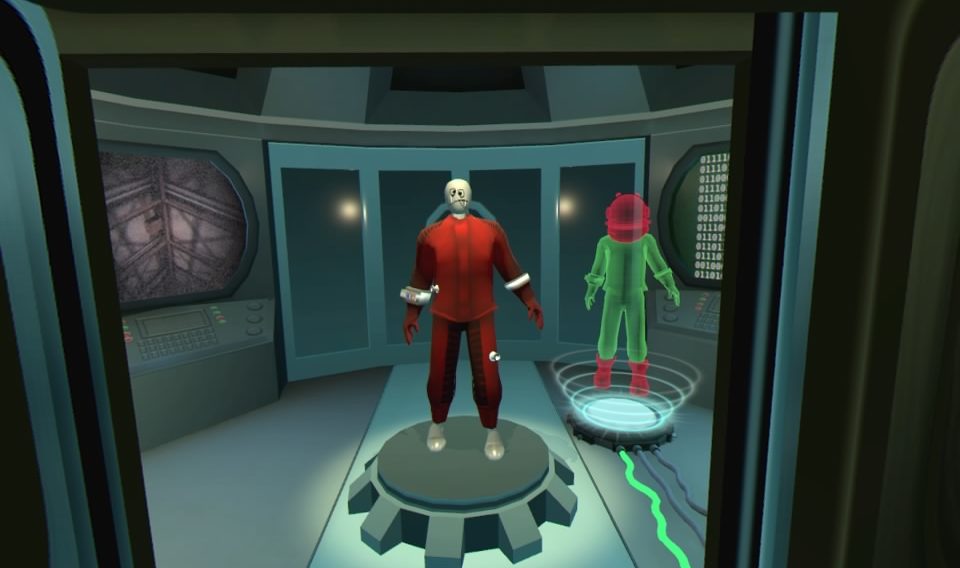
Your task is simple, find the missing components to the space suit!
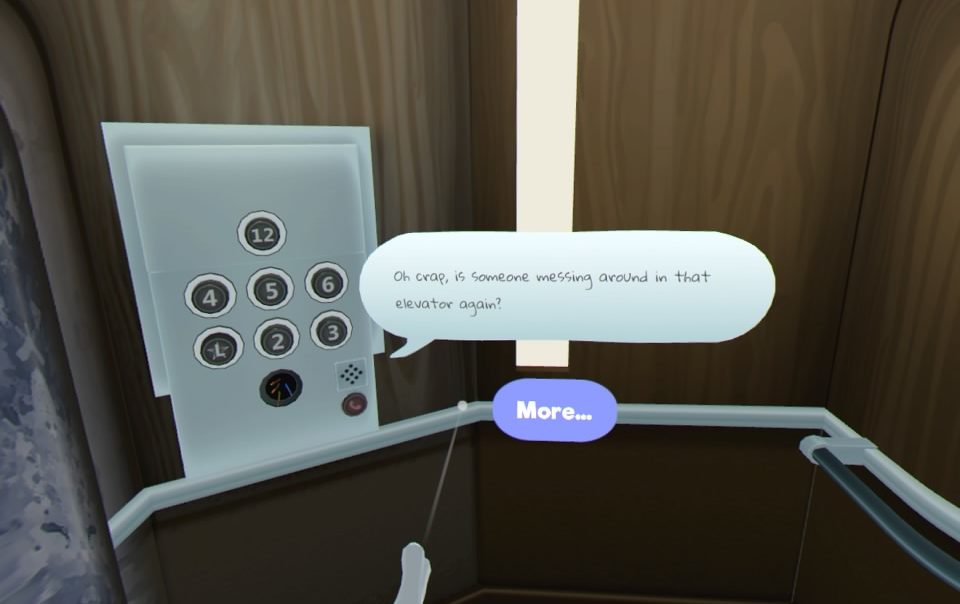
You have 2 methods of control here. Gaze, which uses the DS4 and has you simply look at the item you wish to touch and than press ‘x’ or Move Controls, which give you a pair of cartoony hands to interact a little more personally with elevator and objects around you. A press of the elevator button allows you to change to any rooms you have unlocked. You can hold up to 4 items at a time and you will need all these items to get what you need to dress a mannequin in a space suit…it’s more fun than it sounds. Some light comedic moments are scattered throughout the game as well to add to your enjoyment. If you get stuck you can always call the building manager for help, who will give you clues necessary to solving your next objective. It all works really well and some puzzles do require some out of the box thinking to solve, but nothing that should stop you for to long.
Need help? Just ask the building manager!
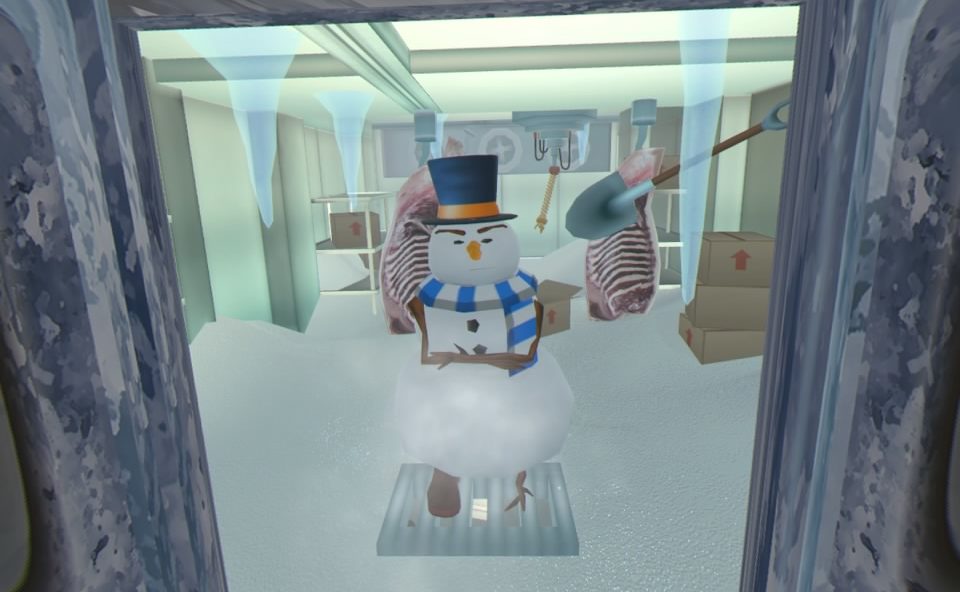
As you travel from floor to floor, each level is a puzzle that, more often than not, will require an item from another room to solve, or may require another room’s puzzle to be solved, changing the environment in one of the other rooms. Initially, only a handful of floors are available but as you solve the early puzzles, more room options open up. It can be a little confusing at times, but trial and error (and that help button) will get you through.
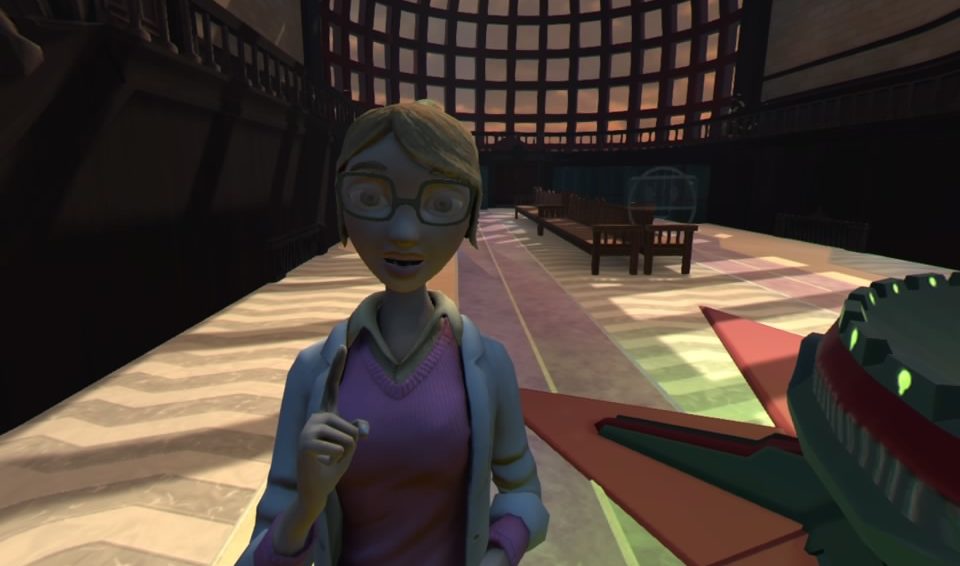
Floor Plan uses a cartoonish art style which looks good enough, though details are a little low, the overall presentation is a delight to look at, especially at 120 FPS. Add in some lighting and shadow effects not seen on its mobile versions, and you get a very clean looking puzzler. Every room you visit has a different theme populated by some odd characters that greet you with animations that are smooth and very polished. The audio is simple using sound effects that fit what you are looking at along with some elevator music to keep you company. Opening your elevator door often leads to a little animation with some corresponding audio that just works together nicely! It’s not the most visually stunning game you have ever seen, but the character and charm behind the visuals makes this a pleasant jaunt in VR
You have never seen a puzzle game quite like this one!
Floor plan is an excellent escape room game that has a few challenging moments and is a unique twist on the genre. With that said, I beat this game in 40 minutes (with a few help button presses) and while I did enjoy it, the short play time is a definite factor in your purchase and once you beat it, that’s it. There is no reason to replay it unless you want to see how fast you can crush it on your second try. If you like point and click puzzle games than I recommend Floor Plan just for it’s different take on the genre and polished gameplay.
What would I pay? $6 is fine! The game time may be a little on the short side but it’s charm and clever puzzles won me over!
Turbo Button provided The VR Grid with a review code for this title and, regardless of this review, we thank them for that!
Developer / Publisher – Animatoon Studio / MEDIAPRODUCCION SL
Price – US $14.99 / EU €14.99 / UK £11.99 / AU $17.95
Release date – February 26th, 2018
Control Method – 2 x Move Controllers
Pro Patch – No
Digital only – Yes
Reviewed on – PS4 Pro
The 1st chapter of Flipy’s Tesla was released back in December 2017 and for those curious, you can my review of that content here. Suffice to say, I found the first chapter more geared toward a younger audience and with the reccomended age for using PSVR being 12+, I wasn’t quite sure if this was the right style of the game for the current generation of headsets. Well, the devs has seen fit to release no more episodes after the first and instead just released the game as whole which involves trying to figure out what happened to Flipy and other mysteries in the mansion/school.
This is Bio and she accompanies your in this little game
It’s move controllers only and those who have played any kind of simulator VR game will be instantly familiar with the mechanics utilized here. With your 2 hands you can grab and interact with items around you to investigate and solve puzzles. Teleportation and click-turning are the only options available as far as movement goes, but most of the game has you stationary as you solve whatever puzzle you are in front of. Early on you pick up some tools and a briefcase that will be needed in future puzzles with the case acting as an inventory system, though it’s almost completely unecessary minus the some in-game cut scenes that are triggered only after you have placed an item in the case.
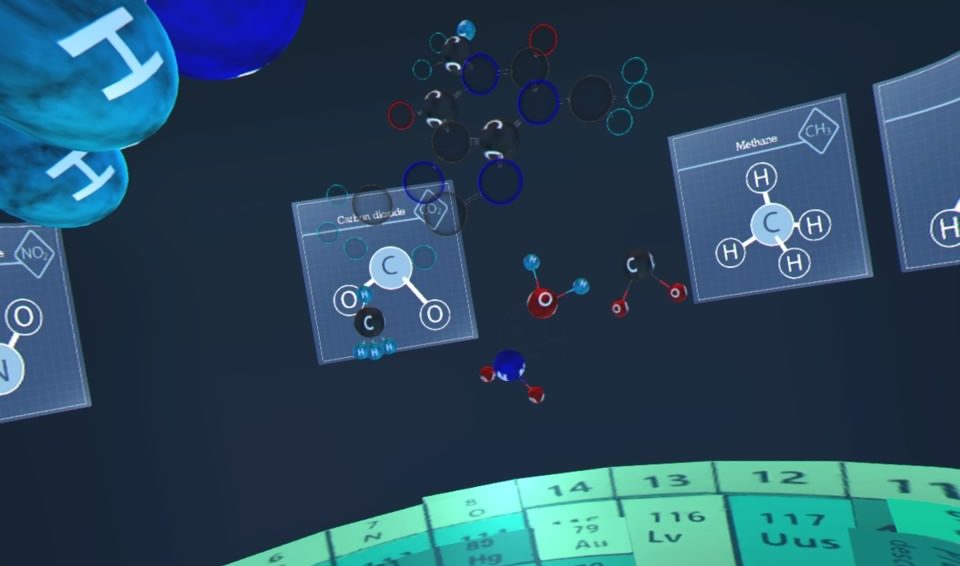
Building molecules has never been so easy!
The visuals here are underwhelming to say the least, but given the targeted demographic, work just fine. Characters are exaggerated and cartoonish, looking like they have been yanked right out of a childrens’ movie as are the environments. The mansion doesn’t have a ton details and feels a little barren, but the few areas you do visit look alright. The voice actors fit their roles nicely as the female lead, Bio, talks you through most of the puzzles and helps you out if you get a little stuck. Oh, and there is a talking Perulican (not a typo) that is supposed to add to the humor, but comes off as an annoying mascot that could only appeal to a much younger generation than myself.
I was disappointed by the amount of content in this ‘full’ release as the 1st episode contains around half of the entire game and includes all the areas you will visit in the game, excluding a few puzzles that take you inside a body and a couple virtual areas that remove you from the mansion ever so briefly. The puzzles are also very simple mostly involving moving an item from point A to point B. As you solve puzzles, Bio talks to you and gives educational tid-bits about molecule composition or facts about DNA. These facts are grade-school level and further hammer home that this is built for a younger audience. The campaign took me a little less than an hour to complete though I feel it may take a tad longer for kids.
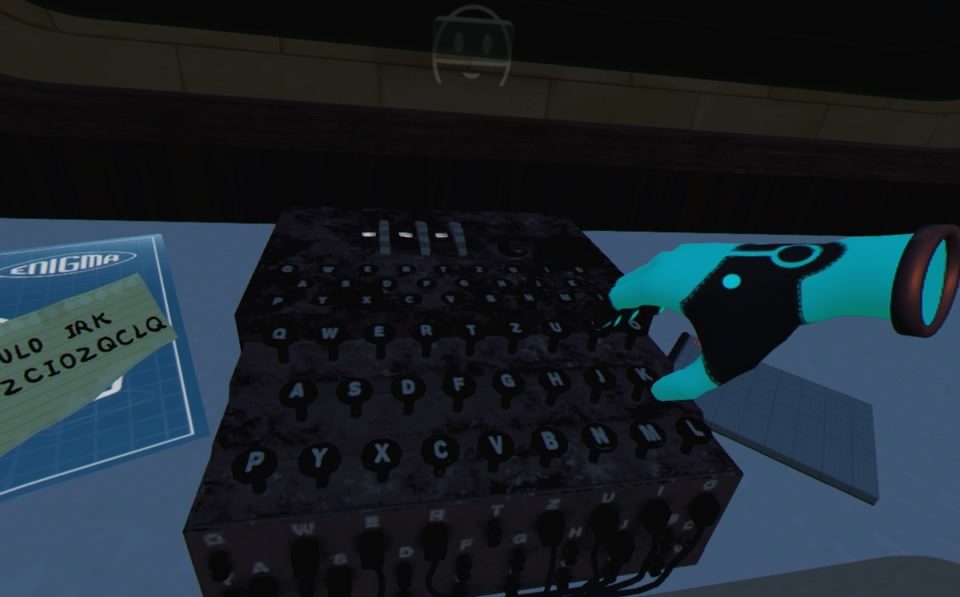
Crack the code!
Therein lies the the biggest problem with Flipy’s Tesla…the target audience. That little warning EVERYTIME you turn on the headset recommends the minimum age for VR to be 12 and up which I think is probably borderline to old for this content, which is a shame. I think Flipy’s Tesla is great introductory VR content for kids and the added educational morsels can make parents feel happy with both their purchase and what their kids are playing, provided you let your kids play in VR. Bottom line is this isn’t for adults and for anyone looking for their next puzzler, unless you have children, you best look elsewhere.
What would I pay? The $15 asking price is to high, especially considering that the 1st chapter is only $1 in the US and contains almost half the content. With an hour of content and simplistic puzzles, I can really only recommend this for kids 12 and under and not for the full asking price. $10 seems a little more appropriate for what’s here.
Animatoon Studio provided The VR Grid with a review code for this game and, regardless of this review, we thank them for that!
Developer / Publisher – Carbon Studio Price – US $19.99 / EU €19.99 / UK £14.99 Release Date – March 8th, 2018 Input – Tracked Motion Controllers Play Area – Standing, Room-scale Store – Steam Reviewed on – HTC Vive
This review has been updated on March 12, 2018 to reflect changes to the game after leaving early access
In the past half a year since I last reviewed The Wizards, it has not only improved, but it’s developed into a landmark adventure game that sets the standard for any future VR fantasy titles. Since August, nearly every flaw with this previously-mediocre game has been addressed. This game is some of the most fun I’ve ever had in VR, making me feel more like a wizard than anywhere else. Thanks to an immersive environment, intuitive spellcasting system, and high replayability, The Wizards is a breathtaking masterpiece that I will continue playing for months or years to come. Just writing this review, I can’t wait to hop back into the action.
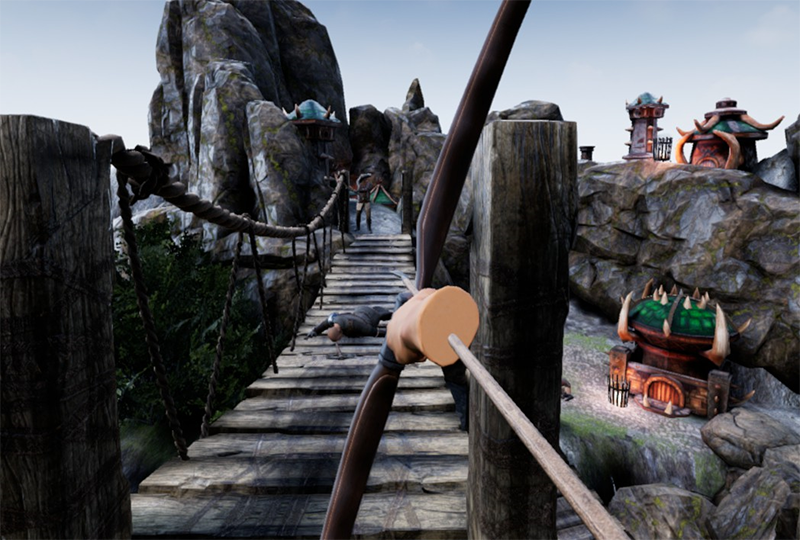
A wide variety of enemy types requires a wide variety of spells to be used
You play as an unnamed wizard apprentice, conjured into existence by the lone surviving wizard of a great war between humanity and orcs. Also serving as the game’s narrator, he sends you back in time through an interdimensional rift to prevent orcs from annihilating human civilization and taking over the world. This story isn’t particularly original or inspired, but it’s built well around the game’s setting. The instructor regularly inserts statements into gameplay, giving you advice and describing the current situation. Many of his statements are hilariously clueless, though many other statements redundantly describe the player’s behavior. Still, this character is overall great, with a superb voice actor and a charming personality that helps carry the game’s otherwise-generic story.
The single most fun and innovative aspect of The Wizards is its spellcasting combat system. There are six unique spells you can cast at a whim, each with different applications. Each spell involves waving your hand in a specific manner, but these movements are all easy to remember and practice. Each simple hand movement mainly serves to add physicality to spellcasting, immersing you in a way unlike any “weapon-”switching mechanic I’ve experienced. Use your bow and arrows to pick off a few ogres, before turning around and electrocuting dozens of goblins using a lightning strike. If an orc gets too close, sweep your arms downwards to send a flaming boulder at him. Is an enemy fireball unexpectedly flying towards you? Sweep your hand inwards to conjure a shield, reflecting it back, before tossing it at an enemy like a lethal frisbee. Flee the scene while hurling fireballs at your foes, using long-range teleportation to reach the ideal vantage point. Once you’re at a safe position, try summoning a ring of floating crystal shards that can be individually shot out like missiles, annihilating all enemies in your wake. These spells can all be cast interchangeably, allowing plenty of freedom in physically-active combat.
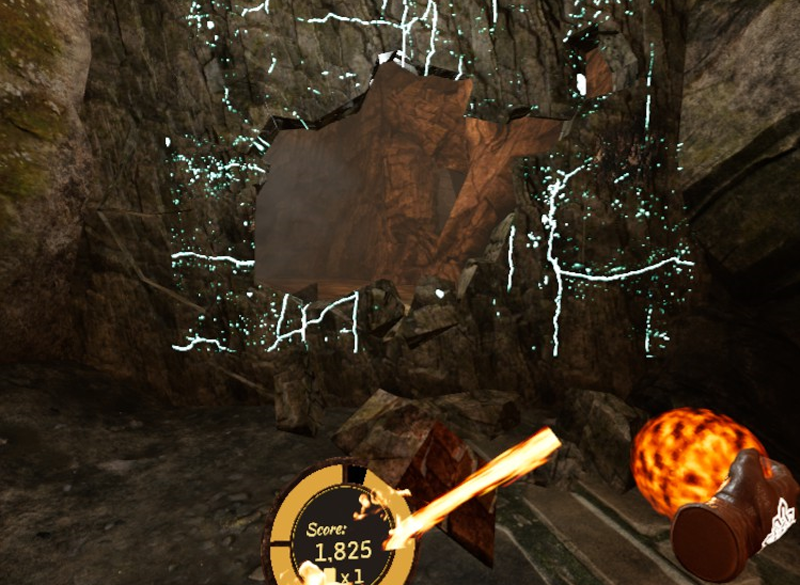
I can never get tired of smashing walls using fireballs
Putting aside the game’s excellent and unique spellcasting, how does its combat in general hold up? Amazingly, for a multitude of reasons. There are a wide variety of enemy types, which attack in challenging and reasonably-sized battles. Sorcerers summon fire blasts at your feet, tiny goblins attack in groups, and massive orcs tower over the battlefield, with many other foes awaiting your hand. Enemies react in believable ways to your attacks, and different spells are ideal for dealing with certain enemies. This is especially true when the game mixes up the challenge using things such as elemental enemies, who are only sensitive to one type of spell. One interesting example is “spell-attractors:” tiny, flying, skittish drones that divert most spells away from enemies until blasted with lightning. The player must always prioritize which spells they should use on certain targets, making combat fast, fluid, and strategic. Throwing physics also work very well, giving slight auto-aim that makes combat feasible, but still challenging. Hurling a fireball across the battlefield and striking an enemy makes you feel like you have superhuman throwing abilities, but still feels skillful and impressive.
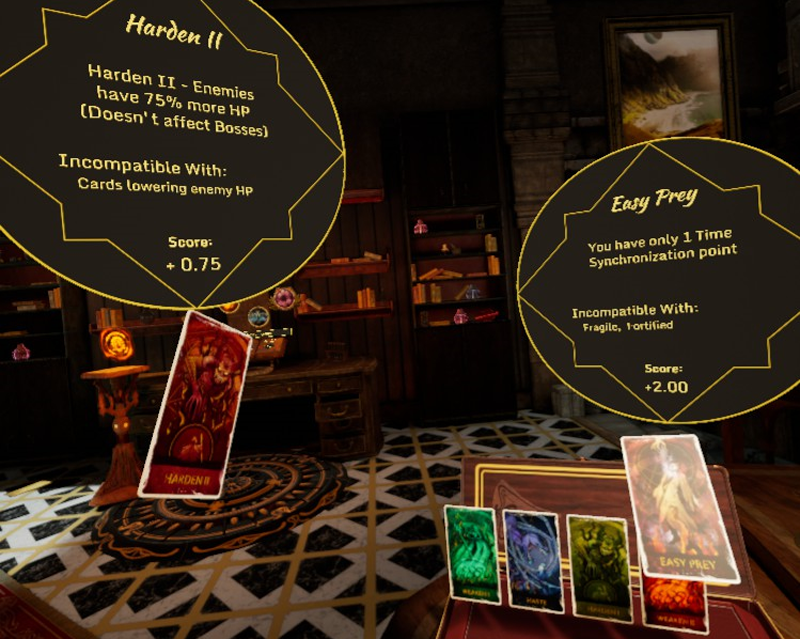
The game is extremely tough and unforgiving, yet always feel fun and fair. Dying makes you restart the entire level, and while this can be as frustrating as it sounds, I didn’t mind it. I had so much fun playing The Wizards that when dying, I seldom found myself disappointed, and more often felt excited for a chance to re-experience the whole level. The game also offers mutators, in the form of “cards,” of which two can be selected prior to any given level. These modify the game in significant, difficulty-altering ways, and affect your points accordingly. Even before beating the game, I replayed every level many times in a constant struggle to top my last high score. Between the game’s difficulty, and the card system it offers, The Wizards is an incredibly addicting game. I’m always fighting to top the leaderboards, competing with the impressive high scores of a fairly large player community.
Cards can completely change the way you play
The Wizards boasts an excellent spell upgrade system that allows you to customize your attack strategy. Passing a certain score threshold in a particular level increases your “spell potential,” and when achieving certain tiers of spell potential, the game awards you with upgrade tokens. I usually only saw a new token once every other level, and the chance to upgrade a spell was always exciting. Each spell has two standard upgrades, which alter gameplay in substantial ways, such as the ability to lay traps using your bow or reflect projectiles using your shield. Once a spell is upgraded twice, you unlock its “master challenge:” Pull off an impressive, specific kill maneuver with a spell to unlock its god-mode ability, such as the ability to throw shields at enemies. Just seeing the master challenge objective always felt exciting and pulling it off was even more so.
In the game’s third level, you’re introduced to the “aether.” This supernatural force is manifested as blue light emanating from shrines throughout the desert and gives you ethereal powers when you touch it. This replaces all your spells with the ability to hurl spears, with incredible distance and accuracy. These can be used to kill phantoms, which cannot be harmed using traditional magic. You can rip the aether off your hands at any point, just in case you need to kill standard enemies. If phantoms show up again, you can reuptake the aether at any shrine that you already lit. This unique system gives the player an ability to switch between wizardry or spear-flinging, allowing them even more control over how the gameplay functions. In practice, the aether mechanic works flawlessly, making an already-fun game even more unique and varied. This type of unique gameplay mechanic is symbolic of all the best single player action-adventure games: Whereas Half Life has a gravity gun, and Bioshock has plasmids, The Wizards has the aether.
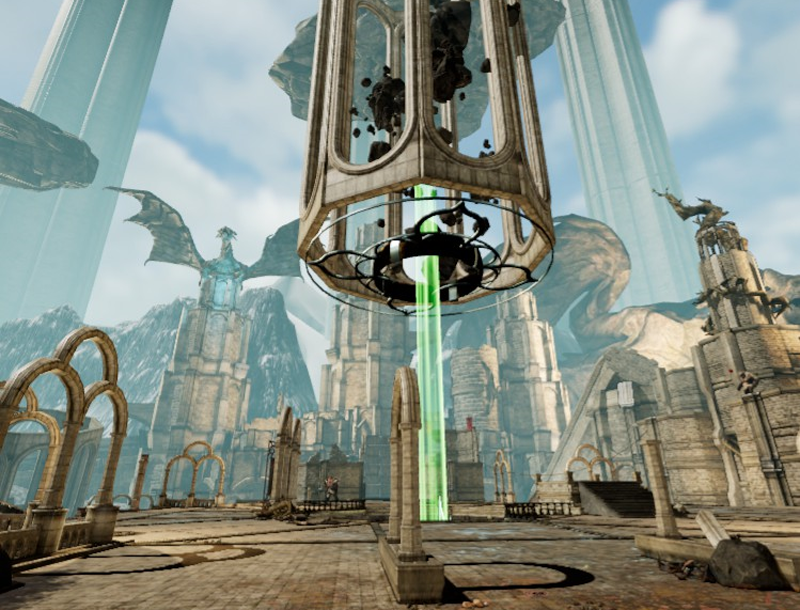
With few exceptions, the environments in the game are absolutely stunning
One of the defining qualities of The Wizards is its excellent environmental design. Each level has a wildly different environment, with large and beautiful landscapes. Although the game is entirely linear, I never got tired of looking at its breathtaking set pieces. Using your teleportation spell, you can hop to specific points in the distance with ease. You can travel between platforms of many different heights, enabling some great multidimensional gameplay. This game has dark, ominous overtones, providing a unique medieval atmosphere all the way through. Graphics are excellent, with photorealistic imagery and many beautiful visuals. Textures are detailed, and lighting has a strong effect on the environment. Overall, The Wizards is an absolute pleasure to look at. Many aspects of the environment are also pleasantly interactive: Pressure plates, door-cranks, and destructible walls are all frequent. The physics in this game are also excellent, and breaking the innumerable wooden crates littering the environment is always satisfying. Behind the breakable walls and sometimes in crates, you’ll find hidden gem shards. Between these, and the mutator cards (which can be found in hidden chests), thoroughly exploring the game’s environment is both enjoyable and rewarding.
Perhaps the biggest improvement seen by The Wizards throughout its development cycle is its content value. Not only has “arena” mode (which is essentially a crystal-defense-driven wave shooter) become its own separate, fully-fleshed-out game mode with unique, replayable value, but the campaign itself has tripled in length. Every level has at least three missions, with huge, frightening, and fun boss sequence at the end of each. Whereas completing The Wizards once took two hours, it now takes 4-5. I found myself fully engaged during this time, and still excited for the many times I’ll replay arena mode. The Wizards delivers all the content you could hope for.
The Wizards also has an excellent user interface, making gameplay and navigation easy. Smooth locomotion works fine, and so does teleportation. When in combat, teleportation is stamina-limited, making both movement options equally viable. Teleportation serves as its own useful spell, letting you reach elevated platforms in the map. It’s an awesome ability that can be relied on by players that suffer from motion sickness, but also benefits gameplay for those who don’t. Therefore, this is among the first VR games I’ve played to strike such a “golden balance” with its movement options. With an excellent physics system present throughout the game, The Wizards also lets you pick up objects and throw them around, though this holds no real gameplay purpose. The level-selection and spell-upgrade tables are present in a home-base map, which overlooks a mountain and is very well-designed. This game was carefully structured in a way that keeps it immersive all the way through.
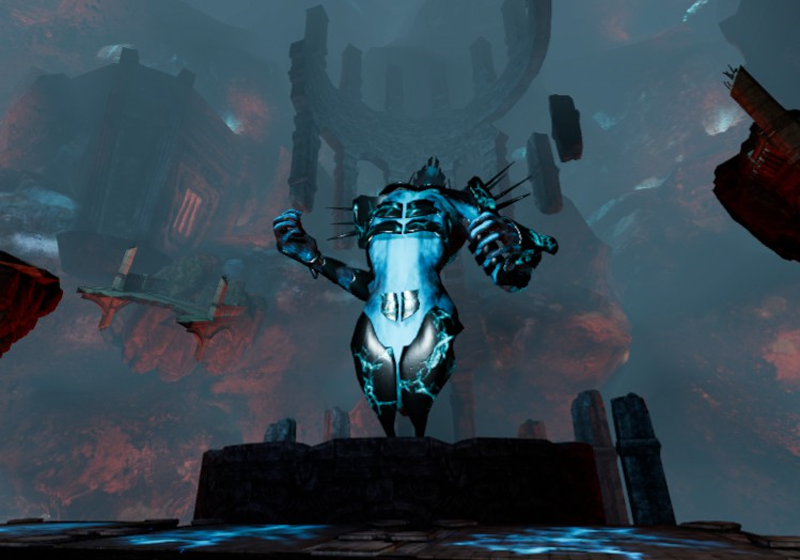
Instinctively, I cautiously stepped backwards from this terrifyingly massive boss battle
What would I pay for it? The Wizards is an engaging, immersive action-adventure game that fulfills all your wildest dreams of becoming a badass wizard. This game emerged victorious from a harsh development cycle, slowly shaping itself into a jaw-dropping VR classic that deserves to be cherished for years to come. I would happily pay $30 for The Wizards, and at $20, it’s a steal. For anyone remotely interested in action-fantasy games, The Wizards is an absolute must buy.
Carbon Studio provided theVRgrid with a review copy and, regardless of this review, we thank them for that!
Developer / Publisher – Studio Trapcard Price – US $9.99 / EU €9.99 / UK £.6.99 Release Date – May 17, 2017 Input – Tracked Motion Controllers Play Area – Room-scale Store – Steam Reviewed on – HTV Vive
Marksman VR is an archery-based wave shooter with a campaign format and dark, photorealistic visuals. This game feels generic and unprofessional at first but becomes extremely fun and addicting as it progresses. You play as “Zachery,” an archer tasked with reclaiming his kingdom, stopping the corrupt King Aaron and restoring peace to the land. In each level, you must defend a gate by eliminating the hordes of enemies that threaten to break it down.
Enemy archers spawn alongside swordsmen and horsemen, and you must prioritize these targets accordingly
Your only weapon is a bow, which handles very well. I initially thought otherwise, as pressing the trigger to pull back an arrow will sometimes miss the bow, and sometimes requires multiple wonky attempts to do so before the arrow will successfully load. As my skill improved, however, I noticed that the bow isn’t actually as unresponsive as I thought; rather, the bow has realistically a small hitbox for pulling back arrows. If you’re quick and careful, you can see the arrow snap into place when held in just the right part of the bow. This is accompanied by a subtle, but helpful sound effect. Successfully using the bow was extremely difficult at first, but with skill, feels realistic and satisfying to pull off.
Marksman VR offers a chart of perk abilities, which can alter gameplay in unique ways. The game gives you a set number of points, which can be spent on as many abilities as you can afford. These include explosive arrows, homing arrows, a self-repairing door, and more. These abilities change up gameplay in unique ways. However, these abilities are badly designed and suffer from a serious lack of variety or balance. From the start, every ability is available to the player. Each one has a more advanced upgrade of itself, which costs more points than its predecessor.
The problem is that while some abilities are extremely useful, the majority are almost useless by comparison. This incentivized me to purchase only the best abilities, spending the whole game never changing my loadout. The best abilities, such as homing arrows, are granted as killstreak rewards that could have been integrated into the game without an upgrade system. For this reason, I believe Marksman VR’s entire upgrade system is arbitrary and obsolete.
You’ll always be stationed in beautiful, picturesque environments while picking off enemies
Marksman VR is composed of many levels, which individually feel like stationary wave shooters. You must shoot all the enemies swarming in front of you, to prevent them from breaking down your gate. These levels are structured in a linear campaign format. They each take place in wildly varying, scenic environments. Some of these are beautifully designed, such as a tropical beach or a cliff face overhand. Some levels are structured in an entirely unique way, such as a level in which you sail the seven seas while shooting away neighboring pirate ships.
New enemies and challenges arise in many levels. Horseback soldiers race towards your gate, massive boss battles require you focus your arrows, and giant trebuchets launch boulders at you in regular intervals. Some environments contain booby traps, that make you get physically active as you dodge an onslaught of arrows. For the most part, these are great and only serve to mix up gameplay. The aforementioned boulder-flinging trebuchets specifically, though, can get extremely annoying. Boulders can be shot down with precision, so seeing one flying towards you isn’t a death sentence. When you’re trying to focus on the armies of enemies running towards you, however, a boulder flying from nowhere towards you becomes more of an annoying distraction than a fun one. After a point, trebuchets appear in every level- sometimes even with a second one next to it. While most environmental traps in Marksman are fun, the trebuchet gets incredibly irritating and makes the game overall less fun.
Each level is noticeably more challenging than the last, helping each feel different. This difficulty, which starts out pretty mild, becomes overwhelming and even rage-quit-inducingly frustrating halfway through the game. Still, this challenge keeps the game extremely addicting, and increases at a fair pace in each level. Marksman VR took me a decently long four hours to complete, though a lot of this time was spent dying.
Marksman VR uses gritty, photorealistic visuals that work very well. Lighting, physics, and blood spurt effects all work excellently. This game is gorgeous and offers better graphics than most other archery games I’ve played. Still, the game performs well with few glitches. Its user interface isn’t bad, but the main menu is designed a bit strangely. It makes you a giant, standing among the sized-down kingdom that you’re trying to protect. Grabbing orbs, that appear in a linear progression, sends you to a level within the environment that the orb was in. This system works fine but feels unprofessional and lacking.
Even pirates can’t escape the power of Zachery’s bow
Marksman’s story is one of its weakest aspects. The game is structured in a linear campaign format, with a large variety of maps and contexts. Each level starts with a paragraph-long description of the events leading up to your next battle, and these captions are the extent of the game’s story. This is why it’s a shame they were written in terrible English, making some parts of the story almost totally illegible. Marksman VR very clearly tries to give itself some kind of story, even having an epic narrator describe it in the trailer. This story falls completely flat, however, giving me no concern over Zachery (sic- did they seriously spell the protagonist’s name wrong?) or stopping King Aaron.
Marksman VR suffers from frustrating design flaws and a weak story but despite those flaws is still exciting and addicting. I’ll certainly be revisiting in the future. In terms of bow and arrow-based wave shooters with non-cartoony graphics, this title may be my favorite of its niche.
What would I pay for it? For four hours of incredibly fun, tough-as-nails archery gameplay, I would probably pay $10 for Marksman VR, which is what it’s currently priced at.
Studio Trapcard provided The VR Grid with a review code for this game and, regardless of this review, we thank them for that!
Developer / Publisher – Fox Leap Price – US $5.99 / EU €5.99 / UK £.4.79 Release Date – April 28, 2017 Input – Tracked Motion Controllers Play Area – Seated, Standing Store – Steam Reviewed on – Oculus Rift
Gem Hunter is a fun game. Just like a 1st person Super Mario 64, the player runs around a variety of themed levels collecting tokens while looking for a large goal item. In Super Mario 64, the item is a star; in Gem Hunter, the item is a large shiny diamond. While the inclusion of a hub world and the simple art style also remind me of 3D platformers of old, the main difference is your mode of transport.
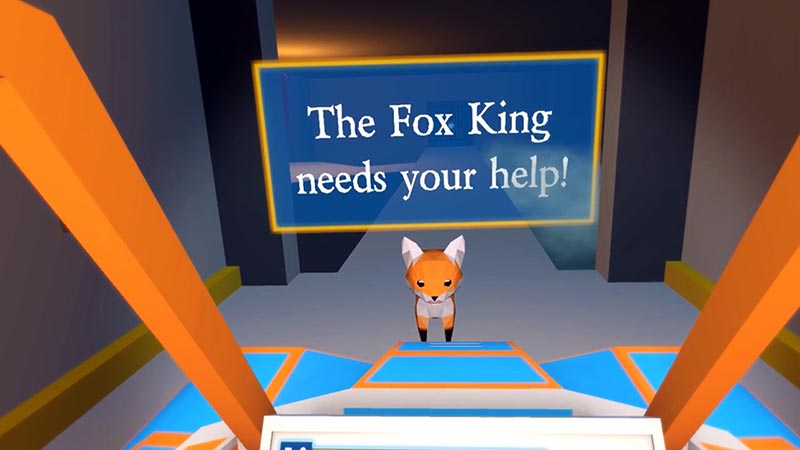
It always starts with someone needing your help.
Gem Hunter allows the player to move by giving them a small ship that uses fuel to go up and forward, while also including a small turret to shoot obstacles and enemies. This ship is clearly designed to be a comfort cage to help mitigate VR sickness, and throughout my time playing the game I did not feel any sickness, although in most VR games I do not.
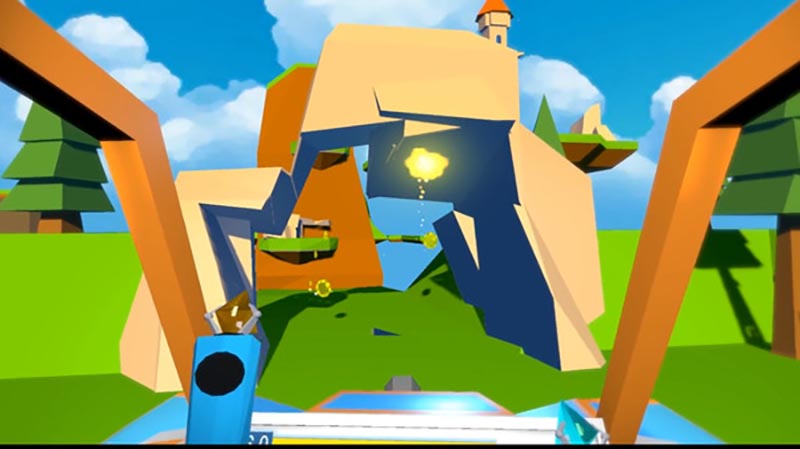
Flying around each of the maps blasting away debris or enemies, all while trying to find one of the several level-ending diamonds is fun. Flying your ship is not super precise, but I didn’t ever find myself failing a level because of the floaty feeling of the controls. The music is upbeat, and the colorful worlds all feel nice to explore. I particularly enjoyed some of the challenge in one of the winter themed maps; I continued to play the map until I found all of the diamonds. There is a story, but it’s light and is easily ignored if you just want to have fun. The 4 bosses provide a nice change of pace to the regular levels, but I did get a bit frustrated with the first boss. I was having such a good time, without too much trouble, that when I did meet her, I was surprised there was a slight difficulty spike.
Graphically the game is fairly simple, nothing flashy, but what is there helps with the world building, and even people with GTX 970 cards and a bit lower should be able to handle the game easily with no struggle. As previously mentioned, the music is great, and all of the sound effects really fit nicely within the games’ style.
Gem Hunter offers up a few customization options to make the ship feel like your own and while most of those options are power ups you’ll need to traverse the game, you can customize the look of your ship a bit. To further make the game your own, choices are presented during the campaign that can give you a few different endings so even though the story isn’t to engrossing, should you enjoy your time in Gem Hunter, multiple playthroughs won’t end the same way.
Armed with a few weapons, you’ll have to shoot your way through not just enemies but the environment as well.
My other gripe with the game is that I would have liked a few more stages, don’t get me wrong, there is a decent amount of content here, I just would have preferred a little more mix up on the levels. The hub world could also use a little TLC as it feels a little barren an empty.
Gem Hunter is fun but is not overly challenging and is a solid throwback to platformers of old. With a few hours of content, multiple endings and customizations I can see myself revisiting this Gem Hunter when I’m in the mood for some classic platforming action.
What would I pay? I would happily pay $5 for Gem Hunter. It’s got enough content for the price point, and it’s fun to play.
Developer / Publisher – Digigo Games / Funsoft
Price – US $9.99 / EU €9.99 / UK £7.99 / AU $14.95
Release date – March 6th, 2018
Control Method – 2 x Move controllers
Pro Patch – No
Digital only – Yes
Reviewed on – PS4 Pro
Rangi has been on my reviewing radar for some time, ever since the Gear VR got motion controls as a matter of fact, but I just never found the time to look at this unique nav point based puzzle platformer. Man did I miss out! Way early on I reviewed a game called Lands End and it straight up blew me away, and though it was a little on short side, the minimalist visuals and simple puzzles won me over and it became, and still is, one of my favorite games for that headset. Rangi has taken that simple formula and made a game that feels like somewhat of a spiritual successor yet stands alone and fleshes out almost every of aspect that was touched on in Lands’ End.
Be careful, not all of these guys are friendly
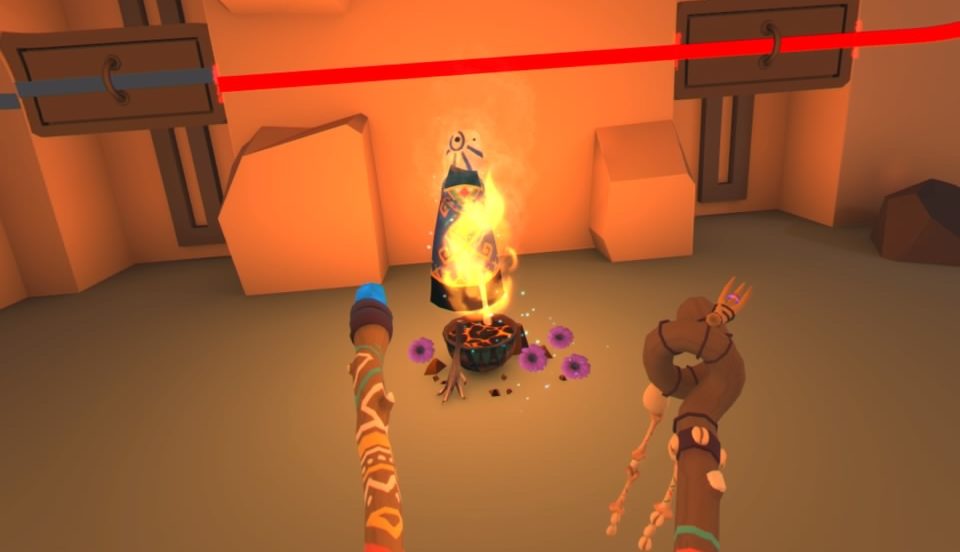
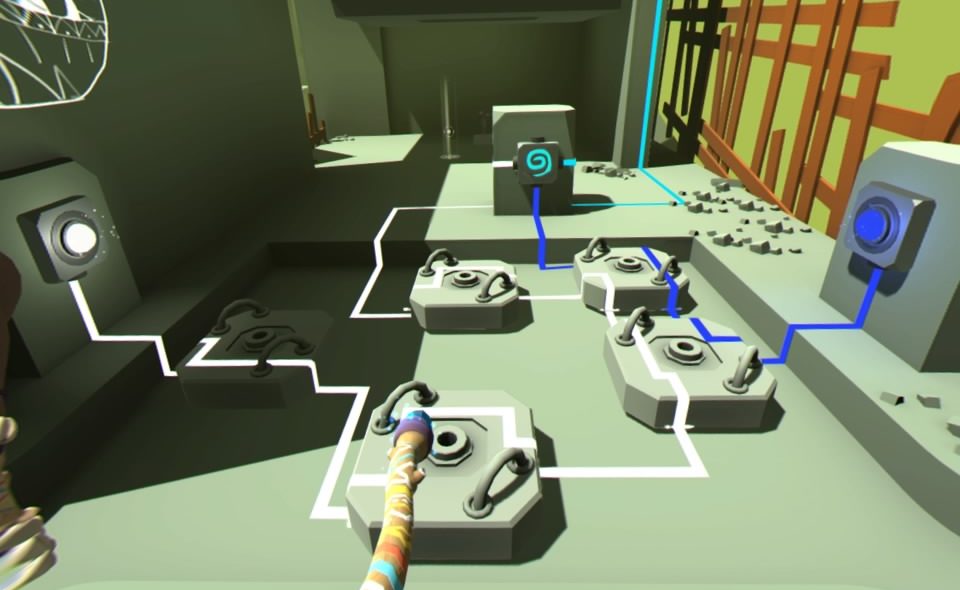
With 2 Move controllers, you are Guzuriki and you are tasked with finding your African ancestors’ lost rhythm. Equipped with 2 different staves you begin to traverse some strange lands, solving puzzles and navigating some treacherous paths. Navigation is done by waypoint so when you see the next white ball, it’s best you target it and proceed forward. Soon enough you hit puzzles which require you to move blocks and complete some ancient circuits all to open the doorway to the next stage. Rangi eases you into the mechanics by slowly introducing each new puzzle variable. Initially you are just moving and turning blocks and crushing these conundrums with ease but just when you mentally check out on these challenges, the game adds a new element like enemies, moving spike walls, buzz saws and few more obstacles which adds some platforming elements to this game that shouldn’t work with the nav system…yet they do. Moving and manipulating objects is all done by using the trigger on one of your wands to highlight whatever you are looking at and triggering it with Move controllers. One odd choice that was uncomfortable throughout my play is that the click-turn buttons are on the opposite controller of the highlight wand, leaving the same buttons on the wand inactive for no real good reason as far as I could see. I would have appreciated if the button on each controller acted the same.
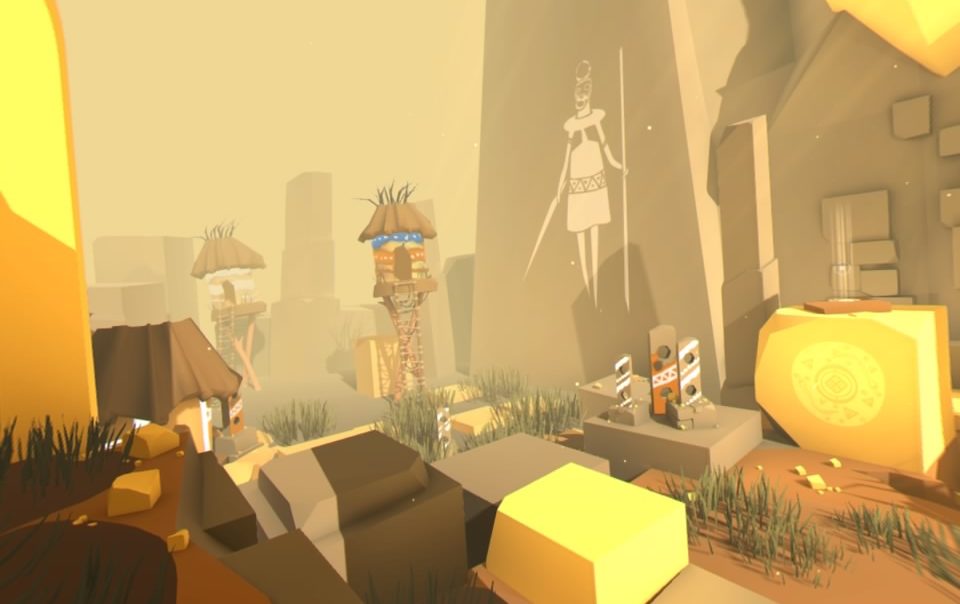
The setting is this game is very unique.
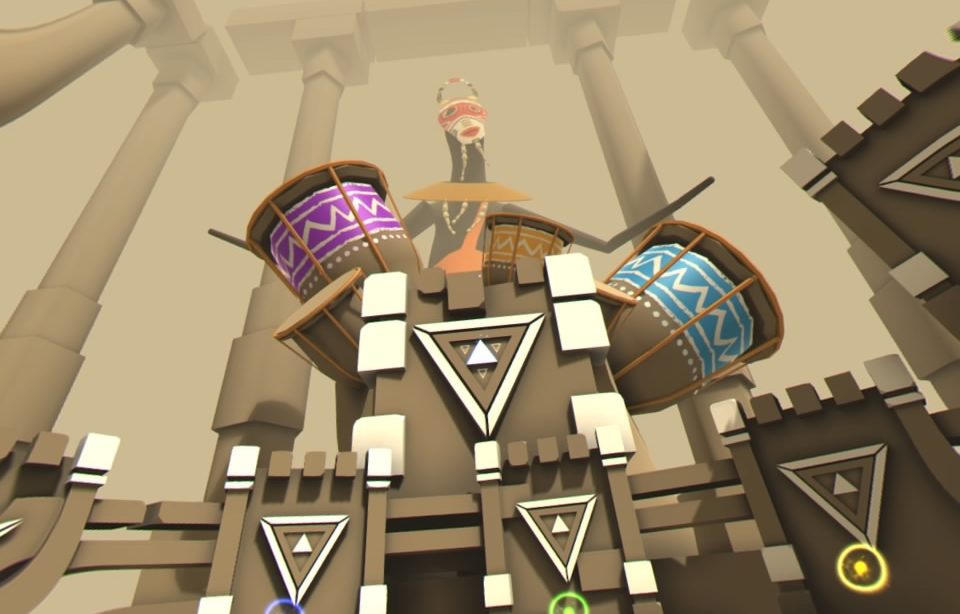
As I said, it’s a minimalist art style here, but that’s not a bad thing. Environments are vibrant and alive using a cell-shaded look, and the scale used here is commendable. Cliff sides, cave systems, temples and a host of other areas make Rangi constantly feel fresh. Occasionally you’ll meet a giant spirit and VR hammers home just how big they really are, you literally fit in the palms of their hand. Levels are large and only get larger as you progress, and the overall polish here is a breath of fresh air. As this is based on traditional African lore, that has bled into the visuals making for an art style that we typically don’t see in gaming, let alone in VR. The sound effects fit nicely here and don’t detract from the game, but another standout is the music which is beautiful mixture of traditional African melodies music that really adds to the atmosphere making this feel unique from other games of this ilk.
There are 22 separate stages here, which may not sound like a lot, but unless you are some kind of super genius, this will take sometime to get through. The puzzles start of ridiculously easy and I expected that to carry through the entirety of the game. This is not the case and just when I was about ready for a break from the monotony, the game switches things up by including new obstacles and much more complex puzzles, and than Rangi does that again, and again. I got stuck a few times on a few of the latter puzzles, which have you teleporting on and moving giant platforms in what I think may be some of the largest scale puzzles I have ever played in any game. Platforming elements are introduced which require you to move at a much faster pace while avoiding enemies, buzz saws and even a very fast-moving lava flow. While the movement system is limited, the folks over at Digigo games have maximized it’s potential to make for a very fun and challenging game.
The later puzzles involve a lot of switches and steps to solve
I did encounter a few issues worth bringing up though most are fairly minor. When puzzles require you to move blocks around other blocks there is zero room for error and no extra space is given in many of these puzzles. What I mean is that if you think you have moved a block as far as it can go one way to move another past it, if that 1st block is not 100% as far as it can go, then it will block the path of the block you are trying to move. Once I became aware of that issue, it was easier to spot the longer I played, but it pops up throughout the whole game. This is doubled down on by some slightly finicky wand controls. When you want to grab an item, a beam of light shoots from your wand, highlighting what you are grabbing but, on many occasions, Rangi seemed to have a hard time keeping up with and tracking my movements. Most puzzles allow you to take as much time as you like, but in the few that rush you, this can get really annoying. Still trial and error will see you through to the end and though I experienced a few hiccups, I thoroughly enjoyed the 3 hour + journey.
This guy is massive and the scale here is fantastic!
Rangi surprised me quite a bit. I have played other games in this genre and they typically lasted no longer than an hour and nothing at the onset of this game suggested otherwise. I never expected the puzzles to get as hard as they did and enjoyed the challenge they offered up. Even the story, what little there is, still had me interested enough to see where this game was going to take me. Rangi still shows its mobile VR roots, but if you like challenging your brain, don’t let this pass by you, it’s a lot of fun!
What would I pay? The $10 asking price is great for this. It’s a beautiful game with a unique art style and loaded with a lot of content and challenging puzzles.
Digigo Games provided The VR Grid with a review code for this game and, regardless of this review, we thank them for that!