THE VR GRID

Reviews‘ alt=” id=’templ_icon_’ width=” height=” /> Hub Category: Reviews

  • Mini-Mech Mayhem

    Mini-Mech Mayhem

    Developer / Publisher – Futurlab Ltd
    Price(PS) – US $19.99 / EU €N/A / UK £15.99 / AU $29.95
    Release Date – June 18th, 2019
    Control Method – 2 x Move Controllers, DS4
    Pro Patch – Yes
    Digital only – Yes
    Reviewed on –PSVR (PS4 Pro)

    Mini-Mech Mayhem is a tabletop multiplayer battler where you have your own little mech face-off in a battle against 1 to 3 opponents.  The game board ahead of you is a large square broken up into a grid not unlike a chess board and the rules and actions you must adhere to and perform make this one of the more intriguing titles to grace our headset.
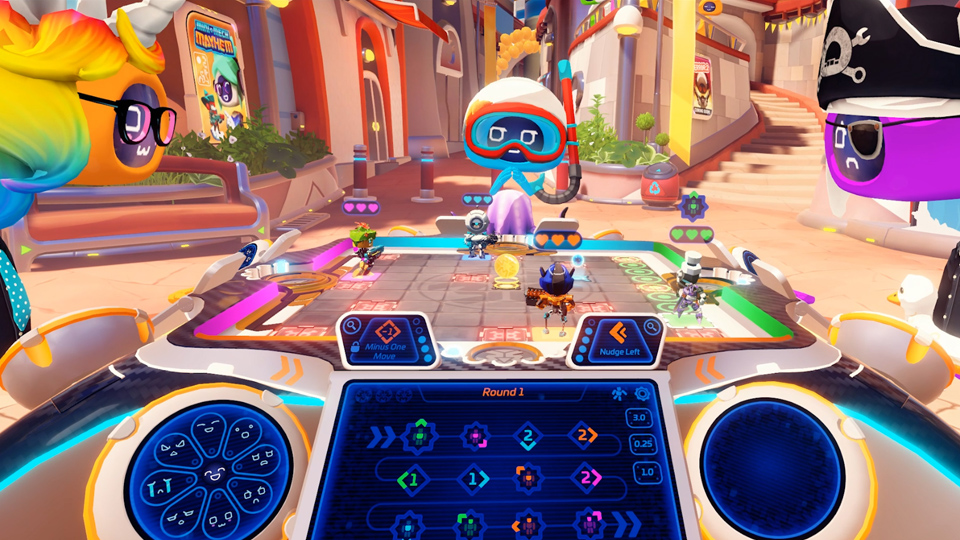
    This is your battle arena!

    You can use a DS4 or the Moves here and either method works just fine though having 2 hands in VR makes things a little easier.  Almost all the gameplay involves selecting actions on a panel in front of you.  An opening, and rather lengthy tutorial, explains all the games rules and mechanics and I highly recommend going through the base tutorial as this game has many levels with which to master.  You can place your mech anywhere along the outside row of tiles on your side.  Each game consists of the 3 rounds with the 1st person to get 3-points winning.  Each round you can perform 3 actions between moving or shooting but you can’t perform the same action twice.  Each action uses action points and the order in which these actions are performed is which ones use the least points.  Of course, you can’t tell what your opponents are doing which turns the strategy portion into a guessing game as you try and decipher what your adversaries are going to do and adjusting for that.  As you can’t perform the same specific action twice you must move or shoot in a different direction for each action in a round.  You can only move your mech in straight lines but can shoot in 45-degree increments or straight as well.  On top of that there are Intercepts which use up power you accrue every round or can be found in the map which can have dramatic effects on a singular mech or the whole board.  Points are awarded be ending a round with your mech on a specific point on the board or destroying an enemy mech.  like I said, play through the tutorial.
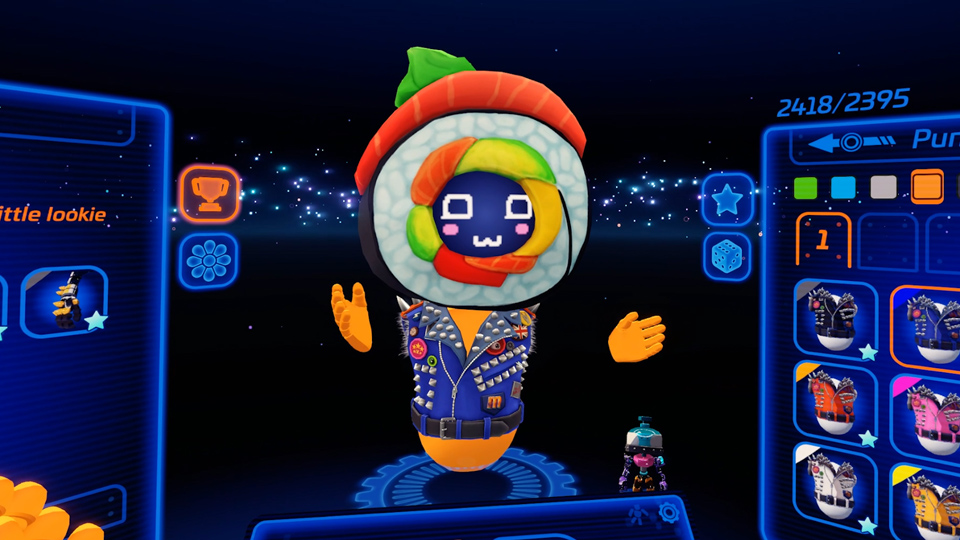
    Customize to your heart’s delight…once you unlock stuff anyways.

    Mini-Mech looks super clean and polished and the emphasis is clearly on being fun and friendly.  There is only 1 play area in the game and 1 board with the game taking place seemingly in the middle of a very cartoonish robot city.  Surrounding you are some onlooking robots who’s heads bob making them look alive.  Other light touches like flags moving in the breeze give some life to the area around but clearly the focus is on you and board in front of you.  You can customize your appearance as well as your mechs so when you face off against others, you’ll see a variety of whacky outfits and mech customizations.  Mech animations are exaggerated, cute and polished and as every player has an avatar, hands are tracked, and you can pick from unlocked emojis to showcase how you feel about a turn of events in the game.

    Just like the visuals, the audio is super cute and friendly.  Your mech makes little digital noises giving it some personality with the lone looping track falling off into the background as you play round after round.  Nothing in here annoys, it just becomes background noise and yes, voice chat is supported allowing you to talk to the people you’ll be facing.
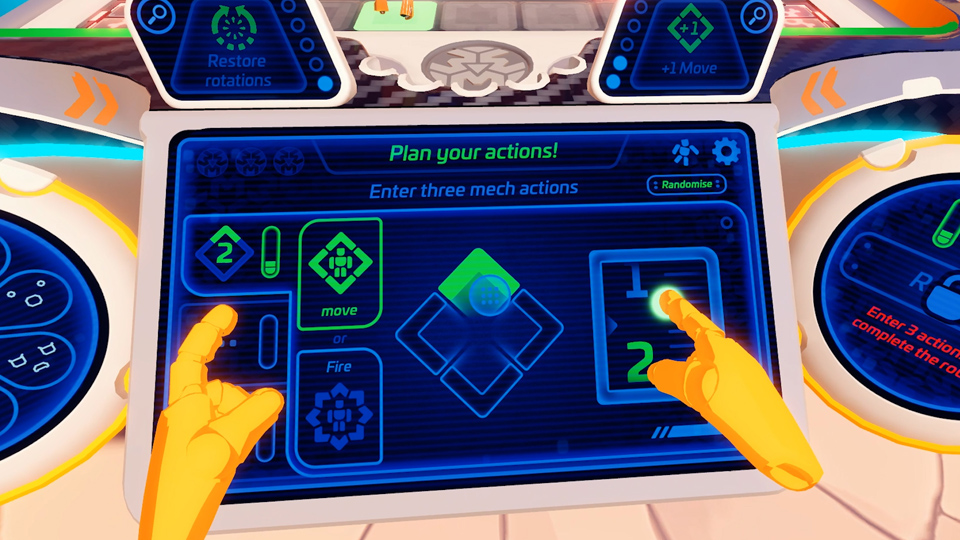
    This panel is your friend, learn the panel…love the panel.

    The level of polish is commendable, and I had more fun with this then I thought I would.  The game is incredibly complex meaning any kind of mastery is going to take a lot of plays.  There are plenty of intercepts to pick from, though the game only let’s you pick from a couple every round and thankfully each comes with a description.   With all the gameplay elements in here, I can’t help but feel that luck plays a very large factor in victories which can make those with the most resolute of strategies frustrated.  It never feels unfair as everyone must abide to and play within the games rules and mastering when to move, how far to move who or what to shoot and when to use intercepts will definitely help you out.  Additionally, the board has trap doors which you can push enemies on top of, and vice versa, and after the 1st round, each successive round moves the ‘goal’ spot but you stay in the same position from the previous round making for some interesting situations.   The game may look simple but it’s not, and after each match you are awarded points to spend on the store on more customization’s for you and your mech giving you a little extra motivation to get better.  I would like to see more avatar and mech customizations but more importantly would be a few different background and board theme changes just keep each match feeling a little fresh as the game does start to feel samey after not too long.
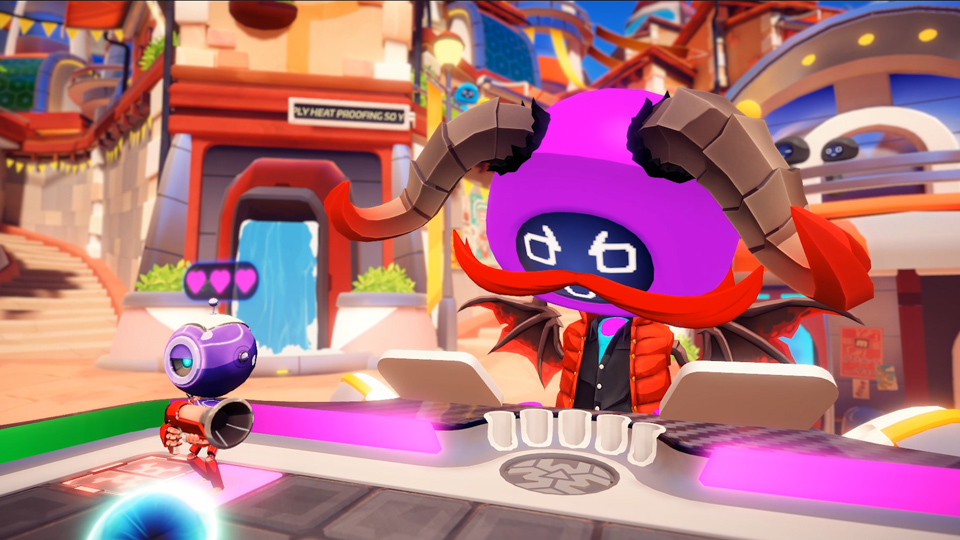
    Everything in this game is crisp, clear and beautiful

    Those issues aside, I really like Mini-Mech Mayhem as it just has a ton of charm.  If you can’t find online players, you can play against AI of varying difficulties but it’s not the same as battling human opponents though it’s still good practice.  The level of polish and charm here is undeniable and the actual game is complex and fun to learn.  The dynamic nature of the game is as much fun as it can be frustrating but as each game only takes around 15 minutes or so, it’s easy enough to turn right around and get back in the game.  If you enjoy tabletop battlers, this is a lot of fun!

    What would I pay?  As much as I like what’s presented here as well the multiple layers to the game’s rules and mechanics, the price does seem high given that the best way to play is online which isn’t always a guarantee.  Add to that the limited customization options and singular play space and I think dropping this to $15 would not only justify the current content, but attract more players, which this game needs.

  • Slum Ball

    Slum Ball

    Developer / Publisher –U24 Solutions
    Price(PS) – US $14.99 / EU €21.99 / UK £17.99 / AU $32.95
    Release Date – June 18th, 2019
    Control Method – 2 x Move Controllers
    Pro Patch – No
    Digital only – Yes
    Reviewed on –PSVR (PS4 Pro)

    Slum Ball, at its core is a Breakout style game.  With VR, we have seen a few of these with Proton Pulse and Cyber Pong being of notable mention.  Well now we have Slum Ball, which takes that classic formula and flips it on its head by adding realistic environments and items as well a bunch of other modes to spice up the gameplay.

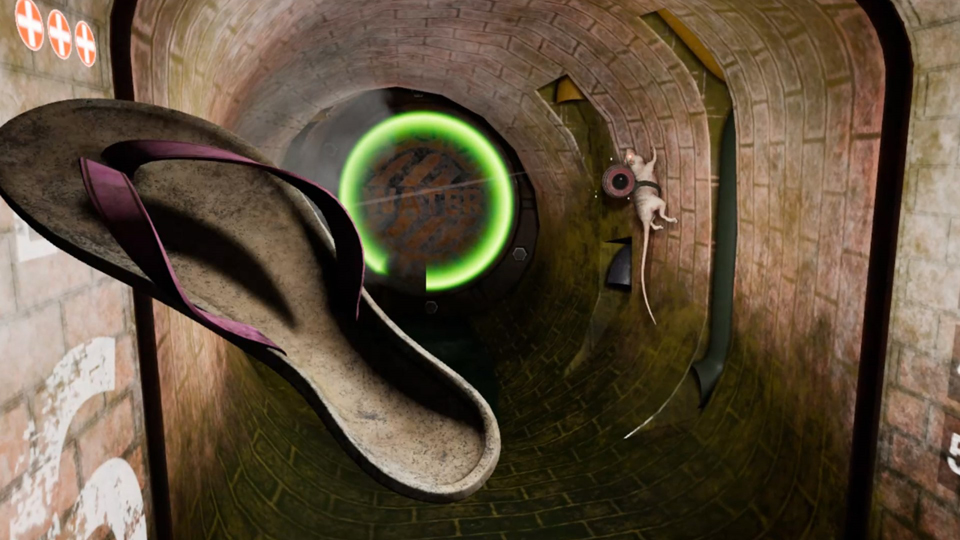
    Get that sandle and get whacking! Note: Realistic lighting effects not included in PSVR version.

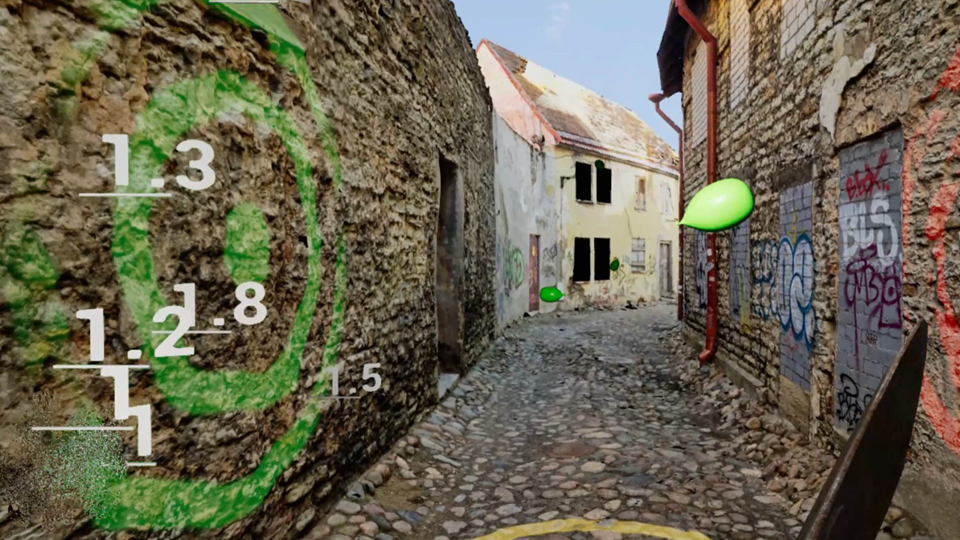
    You can use 2 Move controllers for this, though you could get away with one if you are willing to move around a bit.  No matter which mode you find yourself in, you hold a paddle of some type in your hand and must smack a ball, or in this case a can, at the environment ahead of you, typically destroying items in that area; flowerpots, gas cans and so on.  As you progress through the campaign stages, you’ll find the action gets a little random as objects begin to move around the environment and game modes change up.  There are some rhythm sections where objects come at you to a beat, a target practice section that has hoops slowly move towards you, one that has you bouncing bombs into trash cans and a few more.  I had to try and hit a rat with a canon on his back that launched skulls in my direction and had to hit targets on a wall for max points.  The can is always drawn toward you so it never gets caught in the environment and thanks to the more realistic style level geometry, your can might bounce off errant corners or edges causing some last second frenetic movements to save you from losing health.  At any time with 2 Moves you can swap your paddle from left to right hand with a press of a button ensuring you have the best chance at deflecting those cans, or whatever the game throws your way.

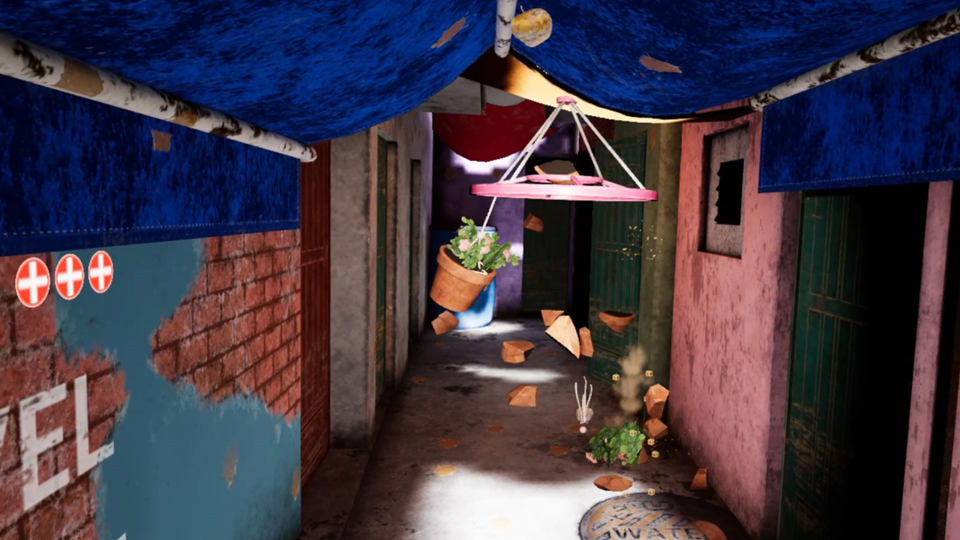
    Slum Ball brags about photo-realistic visuals which I suppose is true enough assuming those photos don’t look good in the 1st place.  The backgrounds change up from sewers to back alleys, roadways, rooms and a few others but none of them look particularly good and textures sometimes take a second or 2 to pop in, which doesn’t help anything.  That’s not to say they look bad, but in a game that hypes up how real the visuals look, the ball has been dropped in here hard.  The environments are all static with targets being added after the fact, at a different resolution then the backgrounds, making them stand out like a bad green-screen effect.  Besides the static shadows in the environment, there are no lighting effects to speak of making everything from pots to chickens and balloons just look flat.  The stuff you are hitting doesn’t look to impressive anyways and Slum Ball ends up looking more like a collection of assets smashed into a game, just with a common theme.

    Breaking pots all day long. Breaking pots while I sing this song.

    With how I just described the visuals, I’m sure you are expecting the audio to be on the same level and surprisingly enough, it’s miles ahead of the graphics.  Interspersed throughout the games is a variety of techno and easy listening tracks that don’t really fit the games aesthetic but are enjoyable enough to listen too no matter which track you get.  Surprisingly, those rhythm stages I mentioned feature licensed tracks from artists like the Red Hot Chili Peppers and Metallica!!  I should clarify that while those artists songs are in here, they are actually covers, not the actual artists singing them and do come off as sounding “off”, especially when you can hear a singers not American accent.  Still, the audio presentation impressed me and kept me in the game longer then I expected.

    My largest issue with Slum Ball is the physics and the environment design.  As the environments are supposed to be more realistic, that includes the geometry meaning your tin can ball can hit an unseen corner and go flying in a weird direction which I’m sure is by design and supposed to be fun, but comes as more unfair and frustrating.  Accuracy is key to high scores and in some cases even passing the stages and I found it to be very, VERY tricky to aim my shots, often having my ball just bounce around the stage until I luckily hit what I needed or failed.  This isn’t always the case and some levels I did breeze through, but it just felt like luck more then skill.   You can adjust your height or move the whole level to ensure you can adequately cover the space you need to guard and levers to your right let you pick from a few seemingly random stages out of the 50 or so avaialabe.  Leaderboards are local only and while the game boasts a tournament mode in the store, I couldn’t find any game option besides the campaign.

    Yup, these are slums!

    Slum Ball isn’t a bad game and doesn’t take itself too seriously.  I enjoyed the soundtrack and even the cover songs amused me.  When it works it’s satisfying and fun, but whenever the game requires pinpoint accurate shots, my enjoyment quickly went to the wayside and I was left feeling frustrated and a little annoyed.  This also boasts being a workout game but given just how little you need to move, at best it’s a warmup for something else and even still, I’d be hard pressed to put it anywhere near the workout category.  If you enjoy breakout style games, you’ll probably have some fun with this one, but be warned, it’s rough are around the edges and has a bunch of levels that aren’t Breakout.

    What would I pay? This is $15 and I don’t think I’d go past $5.  If you are a fan of Breakout style games, then maybe push that to $10 but this really feels like a budget title that needs more TLC.  The content value is here, but it feels more like a collection of not-quite-right mini-games then anything else.

    U24 Solutions provided The VR Grid with a press code for this title and, regardless of this review, we thank them for that!

  • Luna

    Luna

    Developer / Publisher – Funomena
    Price(PS) – US $14.99 / EU €N/A / UK £15.99 / AU $22.95
    Release Date – June 18th, 2019
    Control Method – 2 x Move Controllers, DS4
    Pro Patch – Yes
    Digital only – Yes
    Reviewed on –PSVR (PS4 Pro)

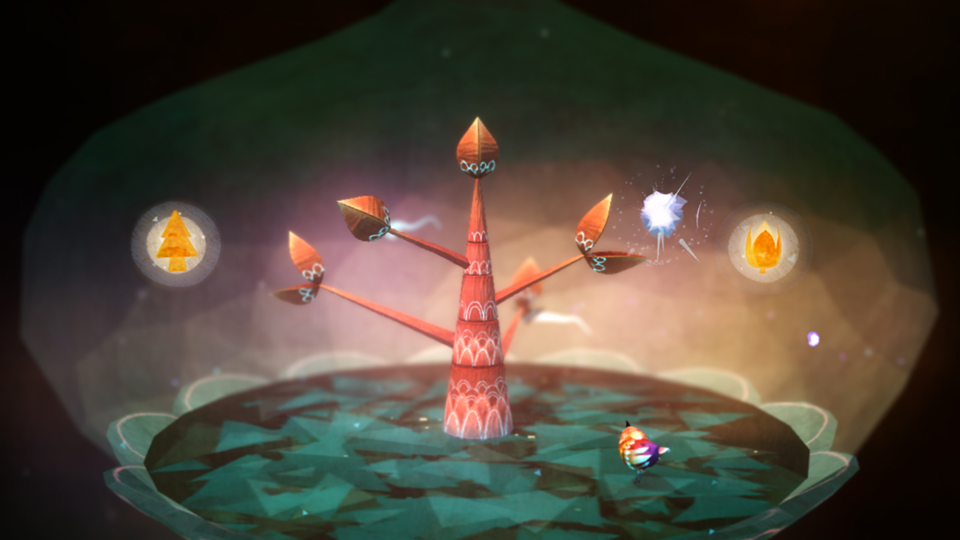
    Luna at it’s core is a fairy tale that involves you helping a little bird restore pieces of the moon,  helping her find her way home and bringing back a little life to the world after Owl has scattered the pieces around in the hopes of giving the night to everyone.  You’ll solve some simple puzzles as you navigate the campaign and play through this story book brought to virtual life.

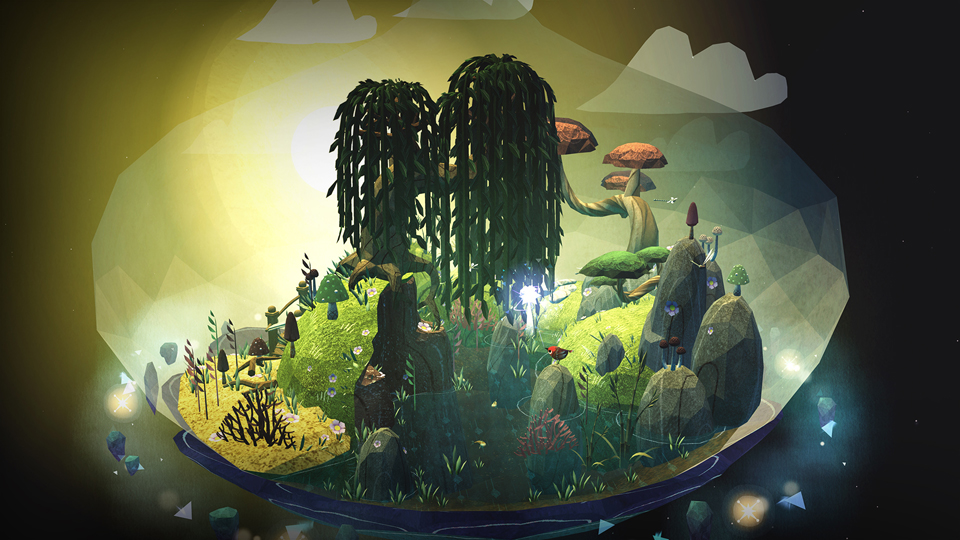
    Each stage ends with a cute little interactive diorama

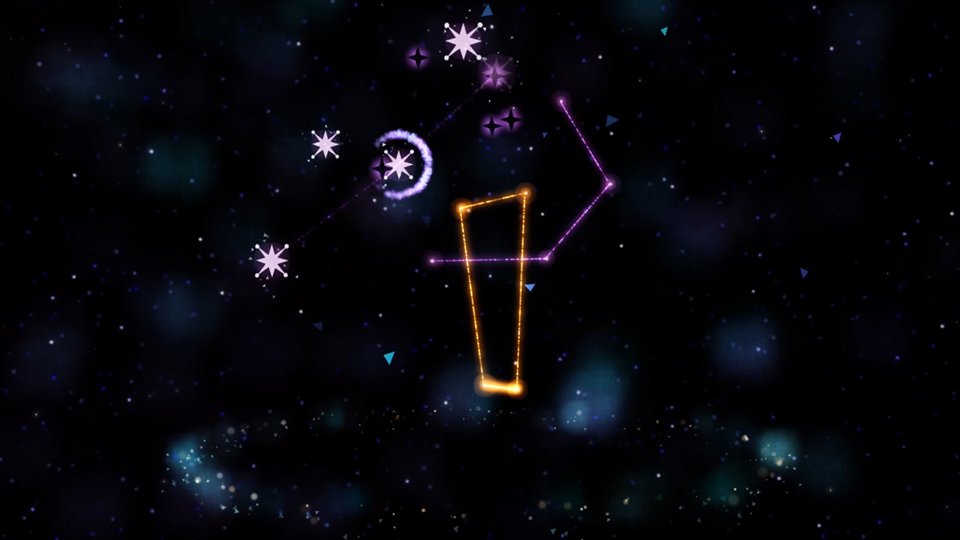
    You can use 2 Moves or the DS4  in here.  Each of the 6 stages, for the most part is broken up into 3 separate areas with the first having you repeat song patterns by tapping them with a Move controller or, with the DS4, moving your cursor over the notes that look like plants after a bird sings those same notes.  Completing these mini-songs brings you to the sky where you must fix star patterns that will make the shape of a plant that must then be used in the last section.  After you fix 5 zodiac constellations you’ll be brought to the final area where you must place all the plants you unlocked, bringing some color and life back to the world and releasing an animal that has been caught under the moons spell.  Every action you perform is of the click/grab and drag variety and while the environments are 3D dioramas, your DS4 cursor moves on a 2D plane but when it moves over an object, it’s position adjusts to reflect that it is on an object making it very awkward at first, but easy enough to get used to once you play around with it for a bit with Moves just having you reach out and touch whatever you need too making for a smoother experience

    Rebuild constellations to help restore the moon.

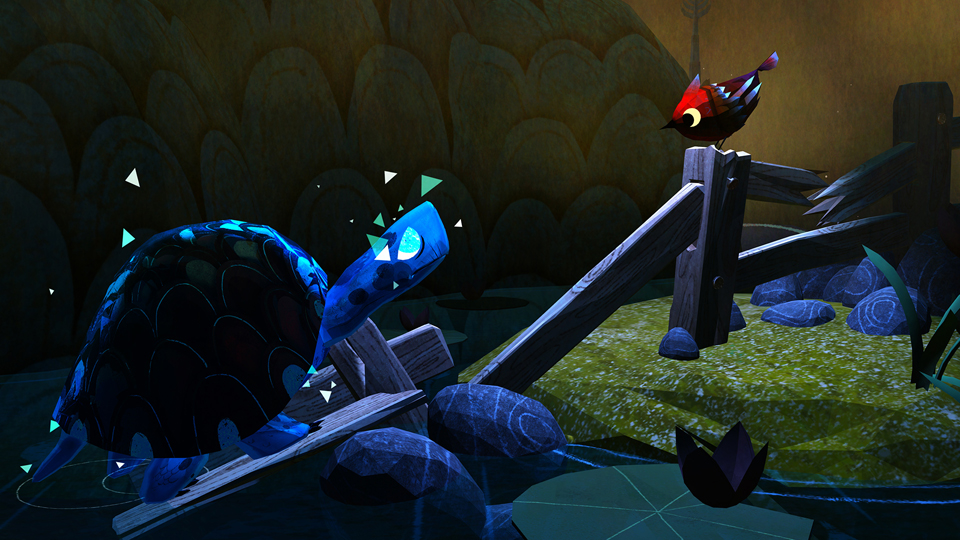
    Luna uses very cartoonish and stylized visuals as if pulled right from a childs story book.  Everything uses a hand drawn art-style that looks good in the headset though does suffer a little from low resolution, though you can zoom in to alleviate some of those issues.  Each of the nature and star stages is a small environment that you can rotate around for a better view of the constellations and where to place the out-of-position stars as well as where to place the plants as each of those levels land’s are drab and lacking much color until you bring some life back to those worlds.   All the textures are drawn in with much of the animals comprised of geometric shapes fitted together to form whatever it ‘s supposed to be making this look like a pastel colored pop-out book and is an art style that lends itself perfectly to the story.
    The narrator takes you on this journey and talks in very quiet and somber tones, bordering almost on a whisper.  He details all the events unfolding before you and does a solid job and telling you this tranquil tale, as if he were reading to you a bedtime story.  The music fits the story with it being quiet and subdued falling into the background until your actions bring the world to life with small explosions of sound and color once again fitting in line perfectly with the storybook presentation.

    Matching the musical notes is child’s play.

    The mechanics are sound enough but the game as a whole just feels too repetitive and slow for adult audiences.  The slow part I’m actually fine with as this story feels like something I would read to my kid before I tuck her in for bed.  The problem with that though is I’m not going to bed, I’m in VR,  making the entire experience come off as subdued and a little boring.  This is doubled down by the other mechanics which just repeat themselves from the first stage to the last and while any individual mechanic is fine in small doses, Luna just has you repeat them with vary little variation.  I dug the core story here, but to get through the 1 and half hour campaign just requires a lot of the same thing over and over.  The most challenging aspect was laying down the plants as you only have a set number of them and must revitalize the entire area in front of you, causing me to move stuff around to trigger the next cut scene.  Don’t get me wrong, besides that one issue everything here works and the game itself is solidly built, I just didn’t find it to be engaging…that said, I don’t think this was designed for me.

    Help save these creatures from the moon’s spell

    Luna, in my personal opinion, isn’t for adults and is a game geared towards younger children.  If you are cool with putting your kid in a headset then I think they will get a lot out of this as the puzzles will be more challenging and engaging to them.  For adults like myself, I just think this misses to many marks and  comes off as a dull and repetitive experience.

    What would I pay?  Like I said, I don’t think this is the type of experience that will appeal to many adults.  That said, I am more then happy to throw my kid into this as I think this was built for kids to experience.  For that reason, I think dropping $10 on this isn’t a big deal, and if you are a child at heart, you’ll probably take a lot from this too.

    Funomena provided The VR Grid with a press code for this title and, regardless of this review, we thank them for that!

  • Darkness Rollercoaster – Ultimate Shooter Edition

    Darkness Rollercoaster – Ultimate Shooter Edition

    Developer / Publisher –Creative VR 3D
    Price(PS) – US $N/A / EU €8.99 / UK £7.39 / AU $13.45
    Release Date – May 8th, 2019
    Control Method – 2 x Move Controllers, 3DRudder
    Pro Patch – Yes
    Digital only – Yes
    Reviewed on –PSVR (PS4 Pro)

    Rollercoasters and VR would seem to be a perfect combo and an easy way to show the masses just how sim VR can be at times though the amount of titles we have in this genre that don’t meet our expectations is ever expanding with only a handful of games showcasing how fun these rides can be.  Darkness Rollercoaster – Ultimate Shooter Edition is a collection of cardboard VR rollercoaster games brought to our headsets, but with a ton more options and game modes borrowing from a few other genres.

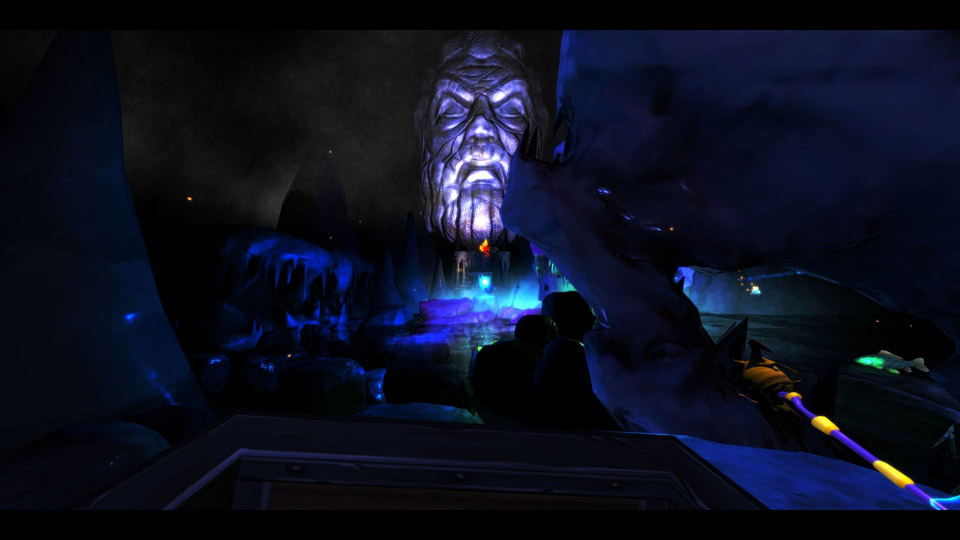
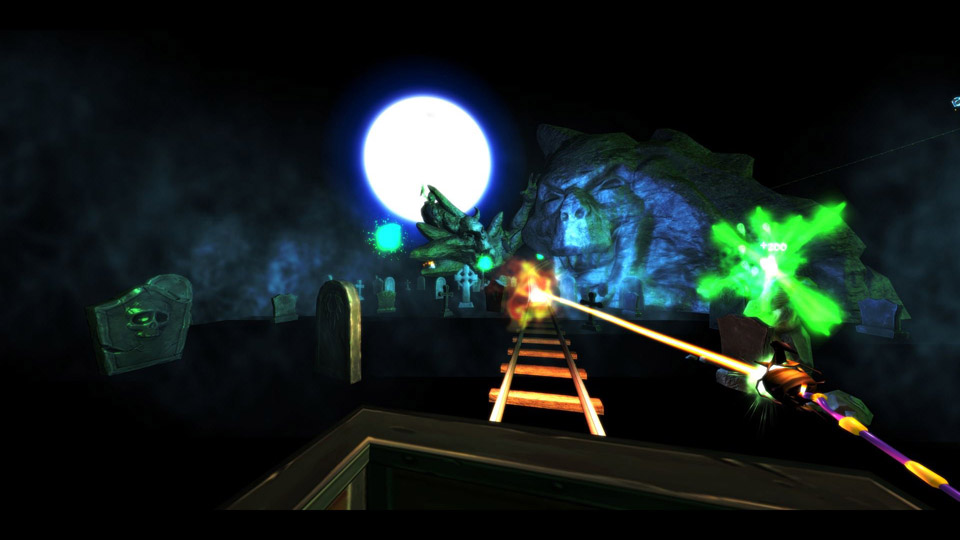
    The different themes are fun to view

    You need to 2 Move controllers for this one and for those that have one, the 3DRudder is also supported. Darkness Rollercoaster consists of a campaign of sorts as you navigate a world-map by button presses or head tracked movement where you lean your head in the direction you want to go, akin to what we saw in Beat Blaster.  The Rudder supplants those controls by letting you move around the map a little more freely, though a lack of turn option makes either method awkward.  A tutorial and practice mode are available that teach all the mechanics including shooting, blocking, slow-motion, a better-vision mode and an explosive attack that wipes out all nearby enemies.  The game plays out like the PSVR classic ‘Rush of Blood’ though definitely lacks the polish of that AAA launch title.  The goal in each course is to shoot as many enemies as you can, while dodging some obstacles with left or right button presses or pushing that direction on the rudder, unlocking the next course or mode.  Besides just playing through the 5 coasters available, you can unlock spectator mode, which lets you play without combat and you can control how fast or slow the coaster moves.  There’s a hybrid mode which will randomly mix 2 stages together which was a little fun and a ‘Beat Saber’ clone stage that has you swiping at blocks with a sword to an electronic beat.  Every combat stage ends in a boss fight and playing through all the courses unlocks a final secret stage which offers a more traditional coaster experience.

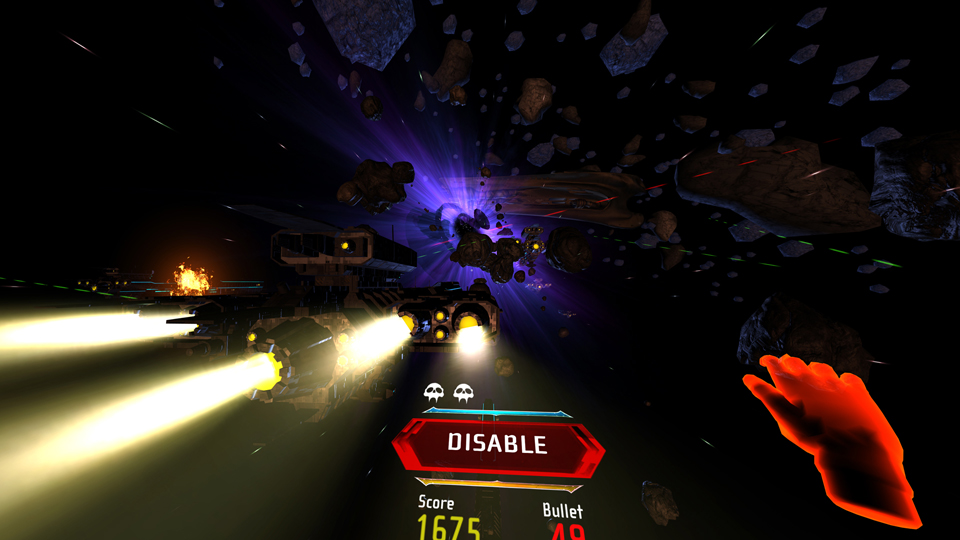
    Flying through a space battle is fun!

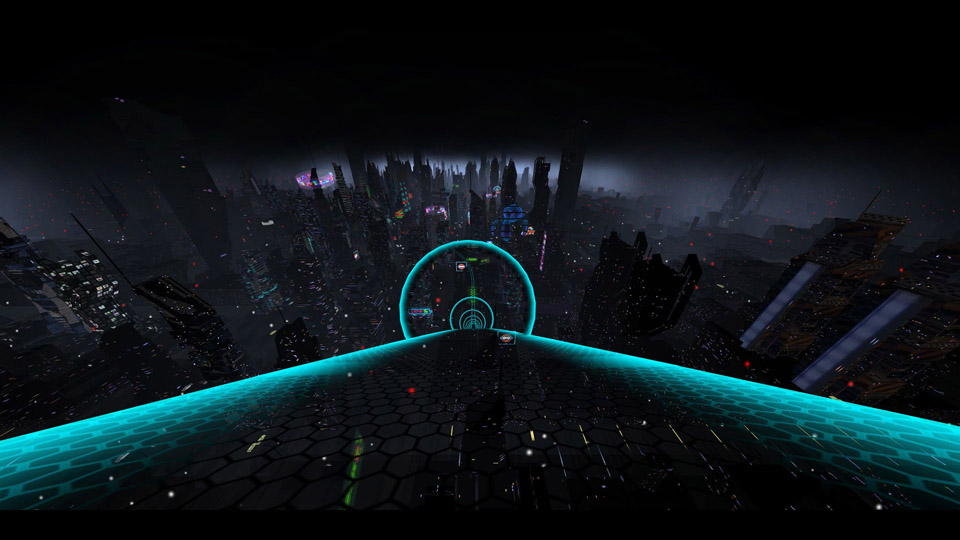
    The visuals in Darkness Rollercoaster are all over the map from simplistic and ugly to to just straight up awesome.  The 4 main coaster you can choose from are ‘Fantasy, Adventure, A Space themed stage and a future type digital world with Fantasy suffering the most from poor and dated visuals.  Skeleton enemies look like N64 sprites and that stage just lacks the detail found in the others.  Adventure fairs better thanks to some larger scale moments and more action-packed settings but the standout for myself was the sci-fi stage where you are cruising through tunnels, asteroid fields, a space battle and contains some very slick moments that look breath taking in the headset.  The same goes for the final stage with that level incorporating some Blade Runner type vibes as well as some other futuristic visuals that pop.  That’s not to say this game is a visual stunner, even with those highlight moments and the overall look does belie its mobile roots.  The Rhythm stages change things up by having you on a straight walkway with beats moving toward you that you must slice or dodge (I think) with most everything in here doing just enough to get the job done.

    The music in here fits each course well  enough an epic an cinematic soundtrack. The little voice snippets that pepper the game could be better with them mostly sounding like the devs used Windows voice recorder to slow down and lower the pitch on normal voices, but they are infrequent enough, save for one dude who harasses you to leave a good rating in the store every time you finish a ride.  I thought the beat mapping for the rhythm tracks was surprisingly well done though there are only a few of these throughout the game.

    Rush of Blood this is not…but it’s trying!

    Darkness Rollercoaster plays out like Rush of Blood light but makes some odd choices that take the game back a step or two…. or three.  For starters, your wand and shield are offset on your hands so even though you have a reticle to aim with, accurate shots can be difficult until you mentally adjust.  It’s like having your gun orbiting the move controllers creating a large disconnect between you and the shooting.  This same issue also plagues the rhythm sections as well and I often missed beats because my swords weren’t ‘in my hands’ like they should be. The dodging mechanic is fun on paper but in practice it just shifts your cart left or right completely off the track making it seem like a poorly implemented and unnecessary add on.  While the shooting does feel off, once I adjusted it was fun to take out the vast array of enemies with boss battles requiring you to be a little more on your toes as they come at you with a variety of attacks though as long as you spam your shots against them, victory is a guarantee.  What this game does right that so many coaster games get wrong is the speed.  The main stages play out in cinematic fashion with your cart moving slower or faster during specific sections but when those sections move fast, they move fast…probably faster than any coaster game I have seen on the PSVR.  If your looking for even faster the exploration mode allows you to control the carts speed for even more (or less) thrill, but that does come at the cost of speeding up all the audio so at the every least I recommend turning off the music to avoid that issue.

    The sci-fi stuff looks way better then the other courses

    Getting through all the campaign content will take around an hour and once you unlock a stage you can revisit at any time to see if you can’t beat you high score.  Shooting stuff is alright once you get used to the weapon mapping, but it never feels natural.  Still, the overall package here is decent even if it is janky at times and the multiple courses, modes and few highlight moments make this a game I’d recommend to those looking for a quick little roller coaster experience, especially for those looking for a bit of speed.

    What would I pay?  This is roughly $10 and I’m cool with that price.  You get enough content to more then justify that cost and while it’s not all dynamite, the mix up in modes and those highlight moments make this a decent value and with luck the developers will keep tweaking this and making it better.

    Creative VR 3D provided a press code for this title and, regardless of this review, we thank them for that

  • FREEDIVER: Triton Down

    FREEDIVER: Triton Down

    Developer / Publisher – Archiact
    Price – US $8.99 / EU €7.39 / UK £6.19
    Release Date – May 30th, 2019
    Input – 2 x Tracked Motion Controllers
    Play Area –  Seated, Standing
    Store – Steam
    Reviewed on – Oculus Rift

    I always love when a VR game or experience comes out of nowhere and surprises the heck of me with a new take on what is capable of being achieved in a headset.  FREEDIVER: Triton Down is a unique little gem that has you playing as Ren Tanaka, a free diver trained to hold her breath for extended amounts of time in deep water.  While your ship is out on the ocean, a rogue wave flips it over with you trapped inside, forcing you to swim to safety as the ship sinks deeper and deeper into the abyss.

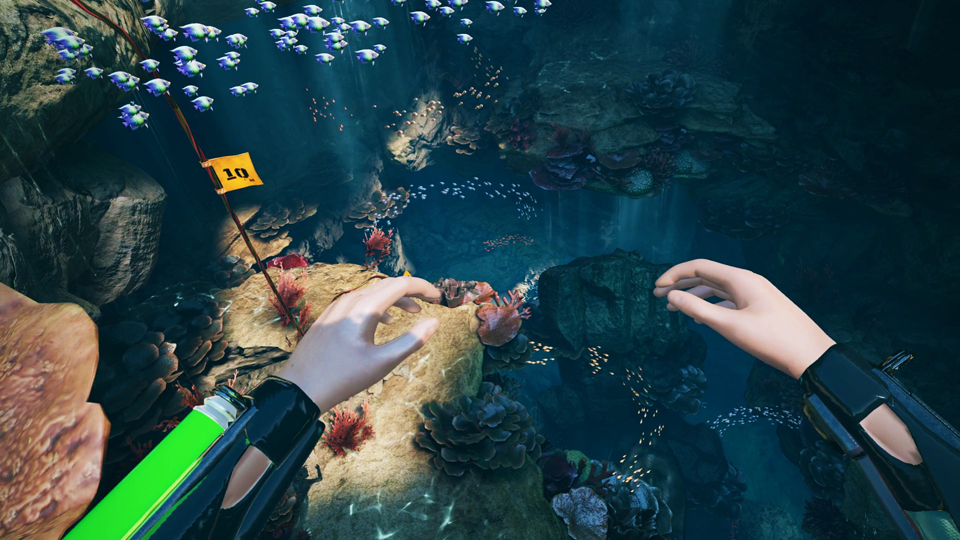
    I love the tutorial area!

    You need 2 Motion controllers for this one and you must physically perform swimming motions to navigate the campaign.  An opening tutorial teaches you how to swim using both arms to swim in the direction you want to move and using 1 arm to pull yourself left or right to turn.   It’s not just about swimming as you can grab specific items to aid you on your trip to safety like axes, doors, handles as well the walls, which will be needed when you have to fight faster water currents.  On your right wrist is a an oxygen meter that alerts when you are getting low on air and beeps when you fill it up.  Air pockets can be found throughout the ship, giving you respite from tense bouts of swimming with oxygen bottles scattered around as well.  From the get go you need to avoid drowning and other obstacles as the water rises and time runs out to get to freedom or sink with the ship.

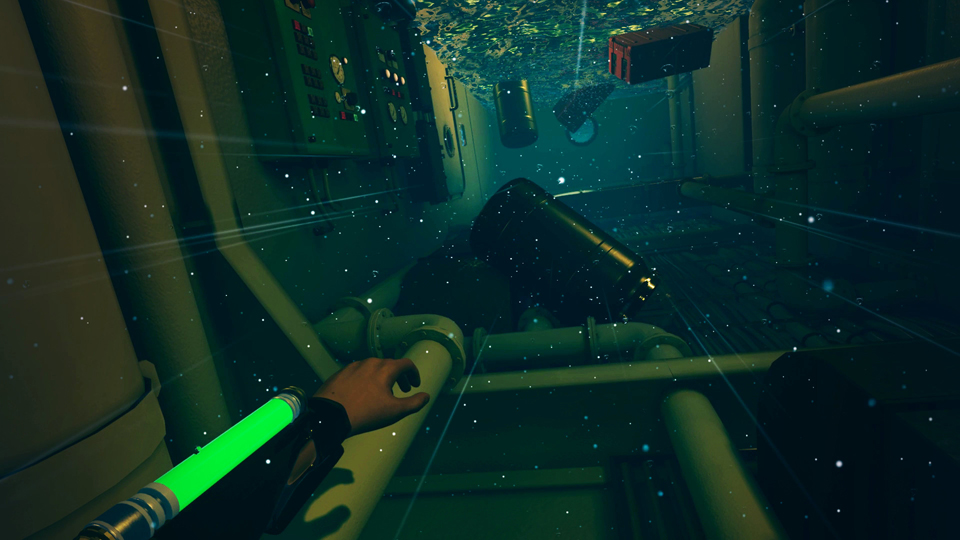
    FREEDIVER looks great in the headset with some nice looking water effects and a nicely recreated ship…that’s upside down.  The ship looks great with everything strewn about and water pouring in from seemingly everywhere.  The ship carries a ton of detail even on low settings with the higher settings adding a more realistic polish to everything.  It’s unnerving when you stumble across your first drowned shipmate and breaking up the action are cut scenes that play out after you *spoiler alert* survive the capsizing, having been rescued by the coast guard who in aggressively interviewing you about the events leading up to your escape.  The opening tutorial, taking place in a cavernous reef is an area I spent way too long in just checking things out and admiring the view as the fish swam by and overall I was impressed by the look of the game.

    Swift currents offer their own challenges

    By my count there are 3 voice actors in here and they all do an excellent job at delivering solid performances.  The star attraction in this one however is the environmental noises as your ship slow sinks.  The creaking of steal, an incoming wave, flowing water and every bump against a wall elicits a wonderful sense of fear and claustrophobia.  Throughout the game, whenever you catch a breath, Ren will talk to herself and it’s worth listening to as once you dive back in the water she stops talking and her reactions to the situation adds a lot of weight to the story.

    For everything FREEDIVER does right I was taken aback by the shorter length…roughly an hour and half and given what otherworldly revelations are told during the story, initially revealed during the tutorial so it’s barely a spoiler, I expected more story.  In fact, the way this game ends suggests that there is more to come, most likely in episodic content.  Despite the somewhat abrupt ending, I enjoyed just about every minute in this linear campaign.  Anything you can and need to interact with is highlighted  with a blue hue so you know you have to pull, push or grab it so no matter where you are stuck, just swim around the area until you find whatever it is you supposed to touch.  As you are replaying through past events, the water isn’t nearly the threat I thought it would be with it only rising as you trigger the next story point.  That’s not to say it still isn’t a constant threat as every time I dove underwater I was hectically looking for the next air pocket or oxygen tank.  It’s not perfect and I had troubles grabbing items and walls forcing some minor frustrations and had even lost a carried item or 2 on my journey through no fault of my own, forcing me to retrace my strokes and see where it fell.  Those minor issues aside, I really enjoyed swimming through the upside-down ship and cinematic way the story was told.

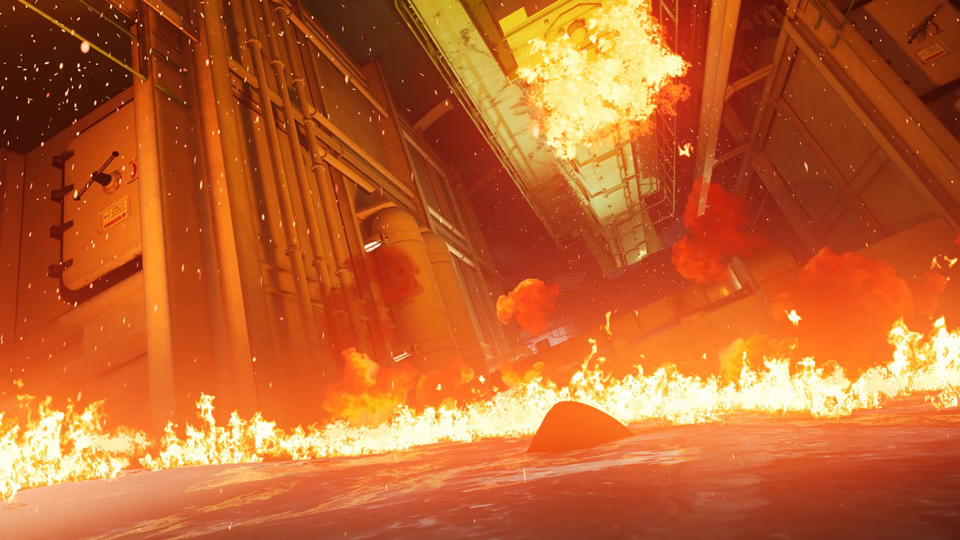
    Even in the water, things get hot!

    FREEDIVER is one of of those unique experiences that showcases just how cool VR can be.  Triton Down gave me feelings akin to when I played Downward Spiral, Detached and Rush VR offering a new, refreshing and immersive way to play games in VR.  Swimming though this vessel, always keeping my eye on my oxygen and looking for my next exit and breath of air kept me engaged from the opening moments all the way to the games ending.  The story feels like it’s only just begun and I can’t wait to see what the next chapter in this FREEDIVER delivers.

    What would I pay?  This is a paltry $9 on steam and worth every penny if not more.  My issues with the games length is rendered completely moot by that price and even if a sequel never appears, I enjoyed my time in this sinking ship.

    Archiact provided The VR Grid with a press code for this title and, regardless of this review, we thank them for that!

  • Space Ops VR

    Space Ops VR

    Developer / Publisher – DevCube Studio / Fibrum Limited
    Price – US $14.99 / EU €14.99 / UK £11.49
    Release Date – May 30th, 2019
    Input – 2 x Tracked Motion Controllers
    Play Area –  Seated, Standing
    Store – Steam
    Reviewed on – Oculus Rift

    Space Ops is unlike anything I have played before.  The store synopsis has you playing as a new recruit in some kind of combat program where you face a variety of enemies in a few different scenarios.  No real back story is given in the game but the bottom line here is that this is a 1st person solo, co-op and competitive shooter that plays out more like an obstacle course then anything else and while that might sound a bit odd, some key elements make it work…and others hold it back.

    The bugs come in all shapes and sizes.

    With your Motion controllers you navigate the environments using the thumbsticks with a bunch of comfort options available to tailor the games to your liking.  Additionally, you also have a teleport mechanic which is pivotal in the game as not only is it a faster way to travel, but will be needed when the enemies become overwhelming and when you need to navigate some of the obstacle courses placed in your way, which require some well timed teleports.  Your armaments are stored at your sides and can be grabbed and swapped with your off-hand and grenades are strapped to your chest, as well as some other unlockable items, that deliver some devastating wide range damage.  Each weapon has 2 modes with enemies you face typically being shielded against one of them so as you progress through a round, you’ll have to switch back and forth as the foes you face change up.  Each round consists of 6 different areas each broken up by barriers that need be taken down by pressing switches, destroying generators, pulling levers and killing all the enemies with an opposing team or player playing through the exact same course making it a race to get to the end.  Each end has a boss fight that requires slightly more strategy besides shoot until it’s dead and by my count there 2 (3) different courses currently available to play through.

    Grenades pack a punch!

    Space Ops looks pretty decent on medium settings and throws a variety of enemies and environments your way.  As each section is wholly different from the previous one, until you become familiar with the courses, you never really know what’s coming next.  One stage starts you off in a hanger, then moves to a jungle setting followed by the interior of a building with one section being in a futuristic mine and in some odd power-core thing that requires you to avoid giant laser beams to get to the other side.  It’s that variety and knowing that there is someone else playing this against you, but also right along side you and if you look to the opposing teams side (you are playing in tandem) you might catch a glimpse of them fighting the same aliens you are.  Enemies look great whether they are giant bugs, muscular looking beasts or more technologically advanced aliens armed with swords and guns.  Bosses are larger in scale and also available are a series of emoji’s you can use to wave to players and perform silly gestures, though these are individually locked until you reach specific experience levels.

    Sound is on point with guns and enemies all sounding as they should.  In-game mic support isn’t currently available that I could tell, but you can use some built in commands to to direct your pal to specific  targets or locations.  An opening tutorial and subsequent ones when you unlock anything new, is handled by a female voice who directs you into using all your available weapons and abilities.

    The enemies come at you from high and low.

    The largest issue with Space Ops VR is the lack of player-base but whether you find a match online or play alone, the experience is identical.  This is because if you can’t find a online opponent, then you will play against a ghost from someone else run.  This can’t be said for the co-op which I have yet to play though hopefully as this game accrues more players I’ll be able to check that out.  My first few rounds, figuring things out as far which as enemy types need what kind of ammo and figuring out switches and levers and so on was a lot of fun, but after my 4th or 5th go, it started to feel repetitious.  With each course being divided into 6 sections, I think randomizing the available sections would have gone a long way to making this feel less stale.  The teleporting system is also a tad finicky, specifically in the sections that require quick thinking lest you get killed and be forced to respawn back at the start of the stage.  With all that said, I really liked the format of being a competitive shooter obstacle course style of gameplay and while the unlocks take a little while to unlock, if you keep coming back, your bound to accrue new gear. Each round typically takes around 30 minutes or so which I also appreciated as that’s just enough time to make your efforts worth it without requiring hours of game time.  There is no way to tell who is playing or if any active games are happening or ending soon and I think having a better lobby system could go a long ways to boosting player activity.

    It’s probably better play with friend…if you can find one.

    Space Ops does a lot of things right in my opinion, but misses the mark on sustaining interest in the game.  Once I hit the same run more then a few times, I was more bored then anything else as the game just devolves into mastering these courses shaving precious seconds off your last run and that’s not really something that sustains my interest.  Additionally there is a sanbox mode that allows you to play through individual stages minus enemies as well custom characters options as you level up.  Space Ops is a refreshing take on competitive shooters and I really enjoyed the way the stages mix up the action.  With a little more content and TLC, Space Ops could easily be an experience I return to regularly.

    What would  pay?  For all my grief, this is only $15 which seems like a decent price, even if the game stays as it is now.  By no means is it perfect but I really dug the format, thought the combat was fun and enjoyed what multiplayer I did play.

    Fibrum Limited provided The VR Grid with a press code for this title and, regardless of this review, we thank them for that!

  • Shadow Point

    Shadow Point

    Developer / Publisher – Coatsink
    Price – US $19.99 / EU €19.99 / UK £17.49
    Release Date – May 21, 2019
    Input – 2 x Oculus Touch Controller
    Play Area –  Seated, Standing, Room-scale
    Store – Oculus
    Reviewed on – Oculus Quest

    I used to say I wasn’t much of a puzzle game guy. Sure, I enjoyed light puzzle elements in games like God of War; and I liked playing mobile puzzle games like Monument Valley, but mostly I’d say I didn’t have the patience for the genre. After playing Shadow Point on my newly purchased Oculus Quest, I firmly believe I’ve not been paying close enough attention to these types of games.

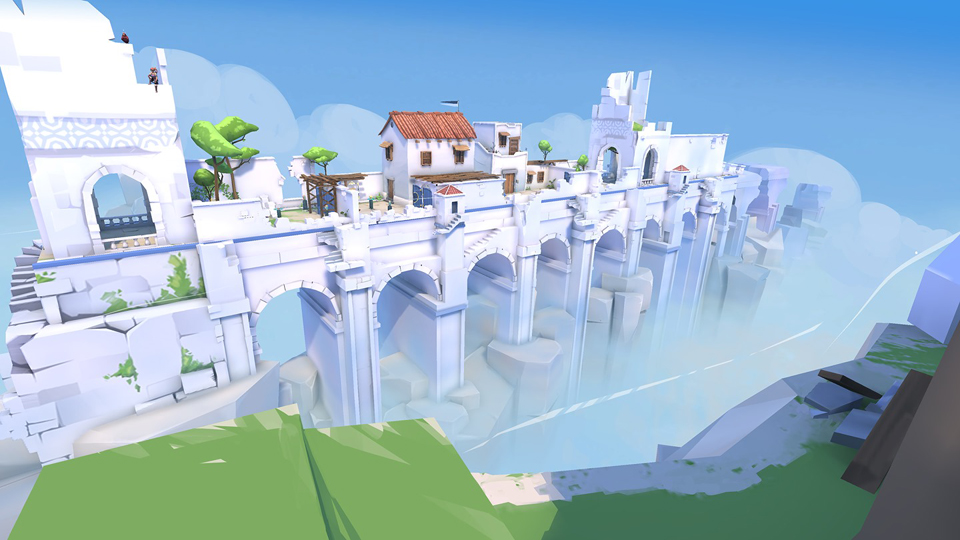
    The art style looks great in the headset.

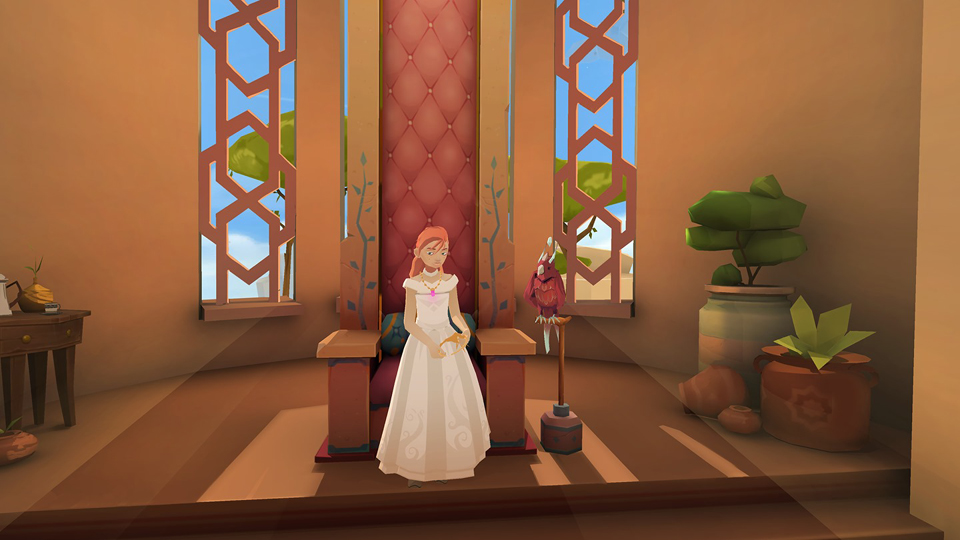
    In Shadow Point you are Alex McCabe, off on an adventure to find your sister Lorna McCabe, who has gone missing after a natural disaster. The story is subtle, and you learn small details through piecing together bits of information gained both from characters in-game, and through the voice over dialogue from Sir Patrick Stewart’s narrator character. You might think his voice would become distracting, but the subtle performance he gives, along with the sparing use of the narrator allows the player to feel immersed fully in the world. As the story progresses small story question are solved, but in turn create more questions. Small bits of time travel, time displacement, and seemingly magical apples all play into the narrative in ways that feel clever and earned.

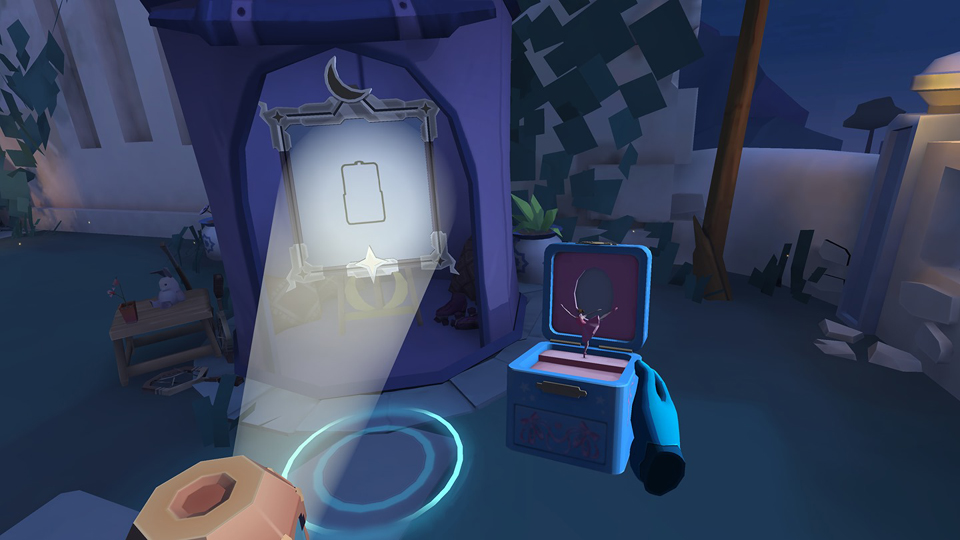
    The bulk of the gameplay revolves around the manipulation of objects in front of light to make their shadows match outlines on the walls. It sounds simple, too simple, but as the levels progress more and more elements are added to add layers of complexity. One such element completely changes objects in your environment, while other puzzles involve mirrors that can have objects passed through them while your reflection hands you something completely different. This simple yet difficult style allows everything to feel solvable, while not being instantly apparent. Both teleportation and stick movement are choices here, and comfort options like movement speed and vignetting are possible. It’s nice to see them catering the game to everyone. This is a game I could see my puzzle loving mom playing, but also my FPS loving brother enjoying as well.

    The puzzle and stage designs are fun

    In each level there are optional “moon puzzles” to complete which give you something to come back and play after you have beaten the game. Some of the more complex puzzles are also worth coming back to, as they have so many moving parts it is unlikely you will be able to have the solutions memorized.

    At no point while playing did I feel frustrated to the point of quitting. There were a few instances where I just felt plain dumb, until I backed away and tried to think of the puzzle from a different angle. There was one moment where I had to stop playing in the middle of a difficult level to go do real world things, I turned my headset off, and went about the rest of the day, all the while thinking about the solution to the puzzle I was stumped on. That night I woke up around 3am having DREAMT the solution to the puzzle. That morning, I tried my dream solution, and it worked! The point here, is the game really worms its way in to your head if you let yourself become immersed in the world!

    Visually the game looks like a more refined and detailed Rec Room, and sort of like Windlands 2. Everything was pleasant to look at and despite the graphical limitations of the Quest I felt fully immersed. I would assume when the game is released for Rift it will be equally appealing, if not more so. Colors really pop, and the world is colorful, unlike some of the drabber color palettes that are common in more recent games. Lighting is key and well managed, which you would expect in a game that is all about casting shadows.

    As the puzzles are light-centric, the lighting effects are great.

    The audio in game is great as well. The music is subtle yet beautiful, and the few “cut scene” type scenes in each level have sufficiently dramatic yet relaxed music to help set the mood. Sound effects feel realistic and non-cartoony. And of course, the voice acting is superb. All the characters feel real, and of course Sir Patrick Stewart’s voice overs are top notch. It doesn’t sound like he phoned this in, which was my original fear whenever I hear big name actors are attached to games.

    My biggest complaint about this game is the lack of multiple save files. Puzzle games are meant to be shared with others, and the lack of multiple saves is a disappointment. Sure the first 2 chapters are easy enough to get through again if someone overwrites your save, but after that the puzzles are way more complicated and it’s going to be annoying redoing several levels to get to back to where you were if you want someone else to try out the earlier levels. Not a deal breaker, but something that could be easy to implement (says the person with 0 game dev experience). It would also be nice to have a chapter select menu after you’ve beaten each level, so you can go back and replay specific levels if you want, directly from the main menu.

    Things get a little surreal

    Shadow Point on Oculus Quest is a great testament to what a puzzle game on a tetherless VR headset can be. I wasn’t getting tangled in cables turning around while solving puzzles, and it let me fully think about the puzzles without worrying about the real world. Simple graphics create a beautiful world, but are ultimately in service to the puzzles, as it should be. The game was designed from the ground up to be about solving the mysteries and puzzles without getting dragged down by game padding or uninteresting ideas.

    What Would I Pay: I would pay the price tag of $20 again, no questions asked. The game plays great, and it feels like a very polished experience. There are enough hours of play here to justify the asking price. VR has its killer puzzle game, and I can’t wait to see how game creators build on these ideas in the future.

  • Virtual Virtual Reality

    Virtual Virtual Reality

    Developer / Publisher –Tender Claws
    Price(PS) – US $19.99 / EU €N/A / UK £N/A / AU $N/A
    Release Date – May 21st, 2019
    Control Method – 2 x Move Controllers, DS4
    Pro Patch – No
    Digital only – Yes
    Reviewed on –PSVR (PS4 Pro)

    Virtual Virtual Reality is an odd game rife with comedy, light puzzle solving and a message about how VR will fit into our lives as the technology improves.  You are the new hire at Activitude, the Virtual Labor System and your job is to serve as a companion to variety of AI constructs who enjoy the company of lesser beings such as yourself.  What initially starts of as a collection of odd mini games soon becomes something much more and gives me the same vibes I had from the Portal and Esper series of games.

    The first time you meet butter is ridiculous!

    You can use a DS4 or 2 Moves here though each is underutilized belying this games original mobile VR roots.  Teleportation and 180-degree turning are your only options and while that may sound cumbersome, and it is, most of the action takes place in front of you so turning isn’t really needed until later in the game. The Moves give you 2 hands to mess around, with each one acting the same, allowing you to switch between Moving or using your Activitude Brand Poly Cleanup Tool which acts as a vacuum, sucking up just about everything around you.  As the controls are somewhat limited, so are the tasks you need to perform which mostly involve moving stuff from point A to B or using the vacuum on specific items.  Every job takes place in a virtual world so you will be constantly putting on and removing headsets as you travel deeper and deeper into the rabbit hole.

    VVR pops in the headset thanks to some beautiful cell-shaded models.  The environments don’t carry much in the way of textures, but the lighting effects and level design makes every aspect of this game pop.  Many of the mini-games take place in rather small areas, but when combined with the art-style, polish and level of care in each of them, the game truly shines in VR.  Whether it’s a Robot arm playing ‘House’, a talking sail boat who wants to admire the sunset or just travelling through the construct these games takes place in, I never once took issue with the visuals and was even impressed by the sense of scale in some of these scenes and the darker more surreal tones that pop up in the latter half of the game, and some of them get weird!

    Meet Chaz.

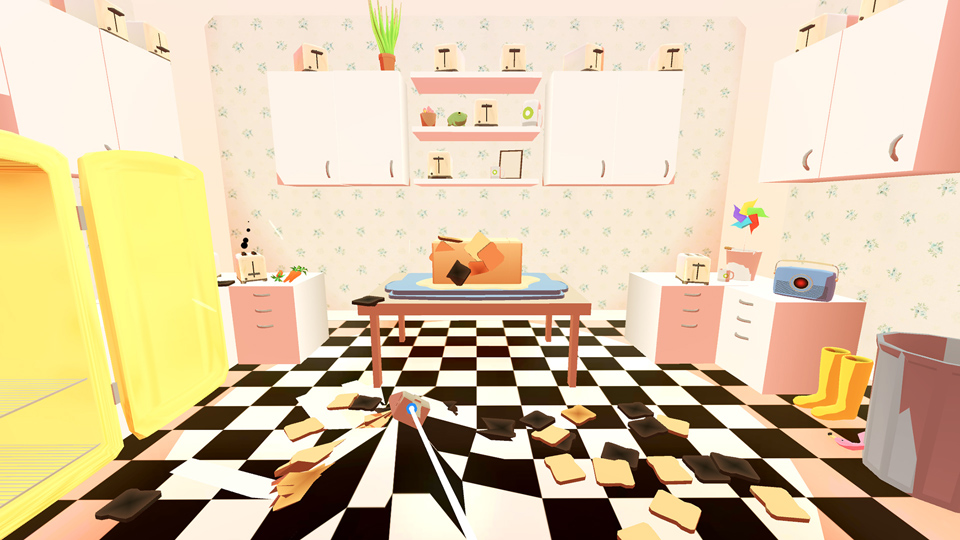
    A large bulk of your interactions are with Chaz, your host who assigns you your next task and the individual AI constructs you’ll meet.   Much of the humor here is dry and self-aware and at the same time is completely ridiculous and over-the-top with a few of the scenarios eliciting feelings like I was channel surfing in the Rick and Morty Universe.  That Butter I mentioned; well, he wants you to rub perfectly toasted toast all over him and makes unenthused orgasmic sounds as you do.  That sailboat had me in tears as he yelled at me for ruining his perfect moment with a ton more characters all having their own weird personality quirks.  Chaz begins to get very annoyed by your efforts to play outside of the assigned box and lets you know and the amount of dialogue in here is impressive, though some of it does repeat if you hang around or replay sessions over and over.  Shout out to the self-aware VR whale who points out her own self existence in VR space and echo’s similar thoughts to my in regard to just how many whales we see in VR.

    The game shouldn’t take you more than 2 or 3 hours to beat though that may not be without issue.  VVR plays out in relatively linear fashion but as your options expand around mid-way through the game, I ended up getting stuck in a gaming loop, repeating the same areas over and over largely due to the lack of guidance on the games part.  I was honestly stuck in ‘Butter loop’ for upwards of an hour before I figured out how to snap out of it and before I did, I was really beginning to dislike the game.  Thankfully, I figured it out and that whale brought me back to the lighter side and I finished the game off with a smile on my face.  There is a rating system in here for the jobs you do, but I don’t know if it matters or affects the story in any significant way as I often did terrible during those little games as I kept messing around instead, much to the dismay of the constructs.  Assuming you don’t get caught in that same loop, VVR is actually a lot of fun to play through and 1 or 2 scenes actually had me in tears with how they played out.  The message gets a little more serious as you play on, but not in an overbearing way.  I do wish this was optimized better for the headset as the 180 degree turn option felt way to limiting and even the teleport system felt clunky.  It’s not game breaking, but I did struggle with both control types with added loss of tracking on the DS4 making the Moves the easy choice to play this one.

    Thing get serious as the game progresses

    VVR is a great little slice of VR fun.  It’s a relatively short experience but delivers a lot as far as entertainment value goes.  Being transported in and out of other VR worlds while wearing a headset is a slick little feeling that can even be a bit jarring at times as you are kicked out of multiple layers of VR back to your lobby, but it all works.  You can revisit the games you have unlocked with the game page stating that there are over 50 areas to play around in.  If you enjoy games like Accounting Plus or Job Simulator, then I bet you’ll take some joy out of this one as well as it feels like those titles, but carries its own, meta weird vibes.

    What would I pay? This $20 on the US store and while I did enjoy my time with the game, my frustrations with the game loops and controls did hamper the experience.  It’s solidly made and entertaining, but I’d knock $5 off of that price for the issues I had.  Still, if you buy it, I bet you’ll have a good time!

    Tender Claws provided The VR Grid with a press code for this title and, regardless of this review, we thank them for that!

  • Trover Saves the Universe

    Trover Saves the Universe

    Developer / Publisher – Squanch Games Inc.
    Price(PS) – US $29.99 / EU €29.99 / UK £24.99 / AU $42.95
    Release Date – May 28th, 2019
    Control Method – 2 x Move Controllers, DS4
    Pro Patch – Yes
    Digital only – No
    Reviewed on –PSVR (PS4 Pro)

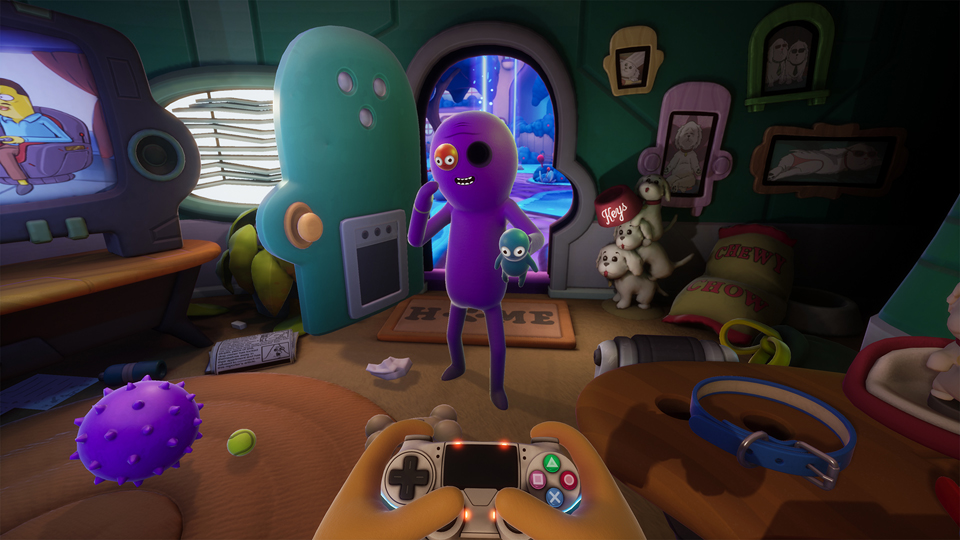
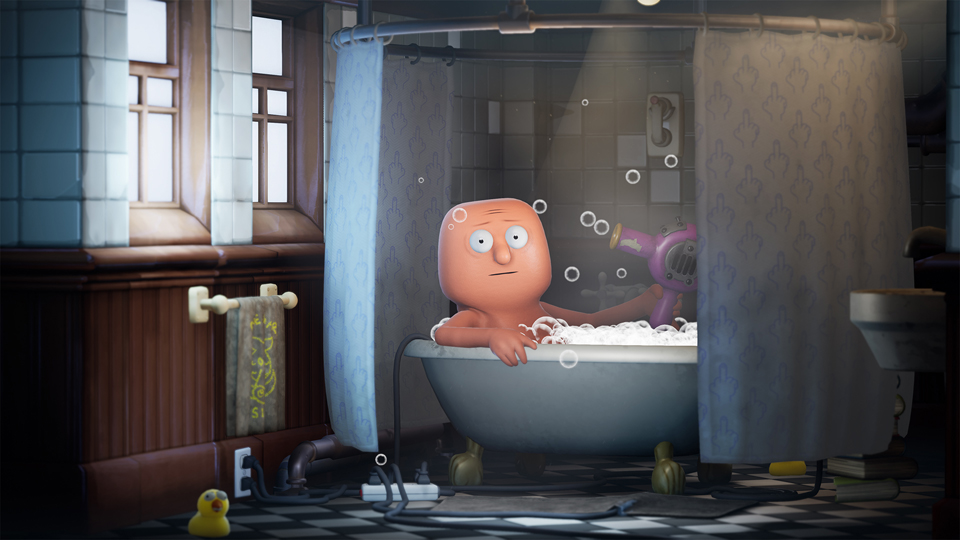
    Trover Saves the Universe is an almost one-of-a-kind platformer except for one other title…Conkers Bad Fur Day.  What Conkers did for us all the way back in 2001 was bring some adult humor to a classically childish genre and spice it up with some language and mildly explicit situations.  Trovers takes clear inspiration from Conkers but doubles down the crass humor and language by incorporating the comedic stylings of Justin Roiland, the man behind Rick and Morty and the VR title Accounting Plus, giving us what is arguably one of the most original titles I have played in a very long time.

    You and Trover are gonna become good friends!

    The DS4 is your only option here and it’s easiest to compare the platforming controls to Astrobot.  The platforming feels very refined as you take control of Trover and guide his every action.  You don’t play as Trover, you play as a Chairorpian, whose dogs have been kidnapped by a rogue Abstainer, a giant being who is using your puppies to ruin the universe.  Thanks to some shared power babies…little beings that Trover shoves in his eye sockets, you are linked together and in VR, that gets interesting.  You are in control of Trover and while he moves around map in traditional 3D platformer action, you need to travel the map by node point, which trover must be on to sync up.  If Trover moves to far away from you, he can’t move any further, so you need constantly move forward with your 4-eyed friend.   This creates an odd juxtaposition between Trover, who has full freedom of movement and yourself as you rely on teleportation and click-turning to move around with no option to change how you move.  As you progress through the linear campaign, you unlock new abilities for Trover like double jumps, quick rolls and upgraded attacks with his laser sword.  You also get the benefit of upgrades with the 1st one letting you change the height at which you view the map and later ones that allow you to grab and manipulate objects which forces you to work in tandem with Trover to defeat enemies and solve puzzles.

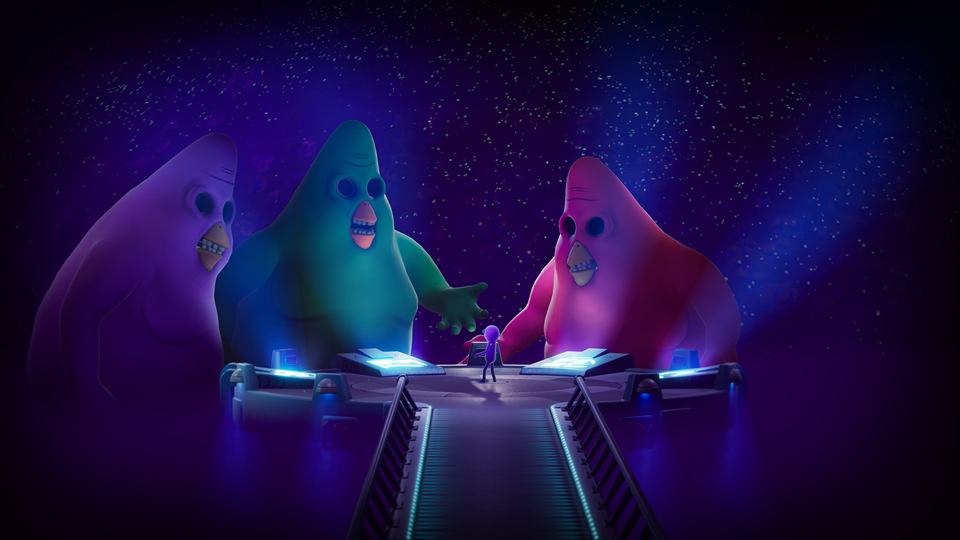
    Meet the Abstainers…they are weird.

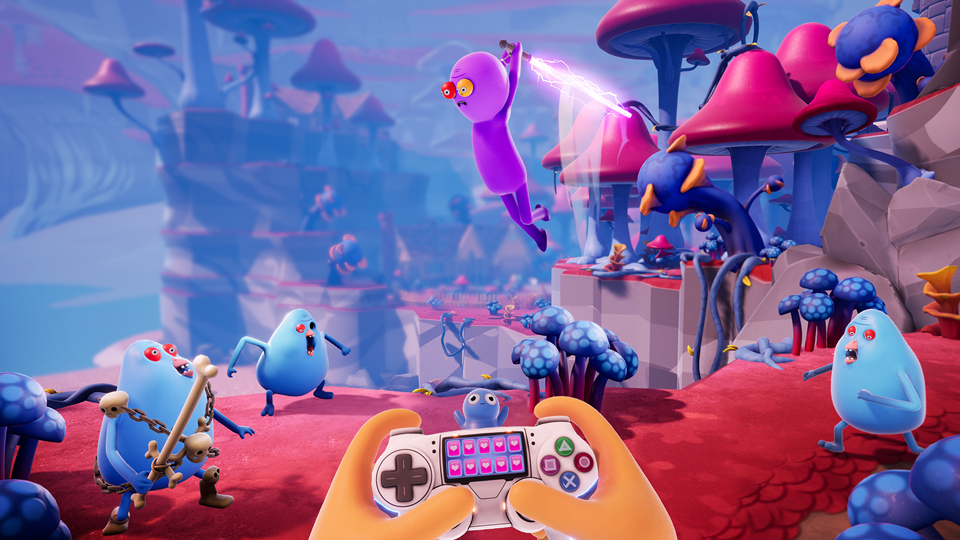
    Trover Saves the Universe looks really good in the headset…like surprisingly good.  Trover and much the NPC’s you meet don’t really carry a ton of detail, but because of that, even when people and objects are at a distance, they still look very clear.  As this is a Justin Roiland vehicle, everything is cartoonish and very VERY familiar to what we would see in Rick and Morty making this feel like an off-shoot story set in the same multi-verse.  Levels are loaded with destructible plants or other stuff which may contain some errant health and each stage has its own theme, in traditional platformer fashion.  Those themes are unlike any you have seen before with stages looking very alien and sometimes very disgusting, like Flesh World, a world comprised entirely of skin and body parts, which is as gross as it sounds.  Everything animates wonderfully and feels alive thanks some solid use of textures and the variety of enemies from little weird looking mushroom creatures to smaller cloned version of the Abstainers keeps the game feeling fresh. and when anyone talks, and everyone does, their mouth animate exactly as they would in Rick and Morty, perfectly in sync with their voices making this feel as much an interactive cartoon as it is a video game

    The platforming is solid and the visuals are on point but the star of the show has to be the audio which is non-stop throughout the 5 hour-ish campaign.  When I say this feels like an extended episode of Rick and Morty, it’s because this never let’s up.   Assuming you dig Roiland’s mix of dry sarcastic wit, improv and jokes that go on way too long, you will be in absolute heaven here.  Trover constantly commentates his own actions, gets very excited when you find a power baby and questions almost every one of your actions.  Enemy troops spout out one liners about kicking your ass and usually say something just as funny as you beat them down or when they die.  Every voice is unapologetically Roiland and his TV cohorts with one or 2 smaller celebrity cameos thrown in for fun.  Many scenes unfold live with you still in control of Trover and don’t stop until whatever NPC is talking to you just starts making fun of the fact that you are just hanging around listening and starts insulting your efforts and intelligence.  That may not all sound appealing to you, but Trovers contains hours of dialogue that is sure to keep any fan entertained for way longer then would be expected.  There is a censored option but don’t let that fool you as all this option does is bleep out the F-word but still lets all the crass humor out in full force making it either a mistake or light commentary on what media censors in the first place…I’m not quite sure which one.

    The combat is very satisfying!

    For as much as I love about this game, there are 1 or 2 missteps.  For starters is the node-based way you are forced to move around the map which never truly felt natural to me.  Many times, I pushed Trover to the limits of our range forcing me to double him back to the nearest node for a quick teleport so I could press on.  By no means is it a broken system, and it’s utilized quite well in some cases, but I do wish we had a camera system that just followed Trover as opposed to what we have here.  Secondly would be your body, which I found got in the way when trying to look at and use your own powers later on.  I love having a body in VR, but when it gets in the way of what you are trying to do, that’s just no good.  I also found jumping to be a little finicky as my view angle didn’t always help with the larger jumps, but after a while my brain, and some ability upgrades, made these jumps easier and easier.  Those are minor complaints when compared to the overall package and the little VR extras that help immerse you in the game.  You are a character not just along for a ride and many characters talk directly to you and wait for your response by nodding yes or shaking your head no.  When these come up, how you respond too a question might just change up the dialogue, but some situations in the game will give you entirely different outcomes based upon your choices which typically leads to comedic situations no matter what you pick.  Bonus power babies are hidden in each stage which not only increase Trover’s heath when you accrue enough but apparently unlock some bonus end game content which I admittedly, have not unlocked…yet.

    ……………………………………………………….

    Trover delivers a top-quality experience in (or out) of VR but is made better by playing in the headset.  The visuals pop, the comedy is all over the map from childish, immature and witty and for myself most of landed and I was laughing all throughout the game.  The platforming is solid, the performances are great and the story, though nuts, is a good one.  Above anything else though, Trover constantly keeps you engaged whether it’s hunting down power babies, enjoying the skits and story or just having the world and characters instantly react to what you are doing.  It may not be for everyone thanks in large part to the brand of humor, but even discounting that, Trover Saves the Universe is a great platformer with a surprising amount of charm…and fart jokes.

    What would I pay? $30 US….sold!  This a great deal for a great game.  The complaints on this one are minor and made almost moot by the sheer amount of polish and Justin Roiland insanity.  Easily one of my favorite VR experiences of 2019.

  • A Night at the Forum

    A Night at the Forum

    Developer / Publisher – Steel Minions / VRTRON
    Price(PS) – US $N/A / EU €4.99 / UK £3.99 / AU $N/A
    Release Date – May 22nd, 2019
    Control Method – DS4
    Pro Patch – No
    Digital only – Yes
    Reviewed on –PSVR (PS4 Pro)

    Do you care to to venture back to the height of the Roman Empire and take in some of the splendor of that bygone age?  While now you can thanks to a Night at the Forum, which puts you in the shoes (boots?) of a guard at the forum, assigned tasks by a bodiless voice that involve exploring the forum and learning about some of that age’s histories.

    See the wonders of The Forum!

    You can only use the DS4 here and while you can explore just about any point inside The Forum, you can only navigate my node-points and click-turning making for a very comfort conscious effort with no locomotion options available.  You can pick up and view items scattered around with some needing to be transferred to different spot in the Forum which you can store with a press of the ‘O’ button.  Early in this experience you are given a list of tasks to perform as well as a map of the area and completion of these tasks ends the game.  Many items also have audio logs attached to them that give a little tidbit of info regarding the goings on in Rome at the time with topics like the judiciary system and politics being brought up throughout.

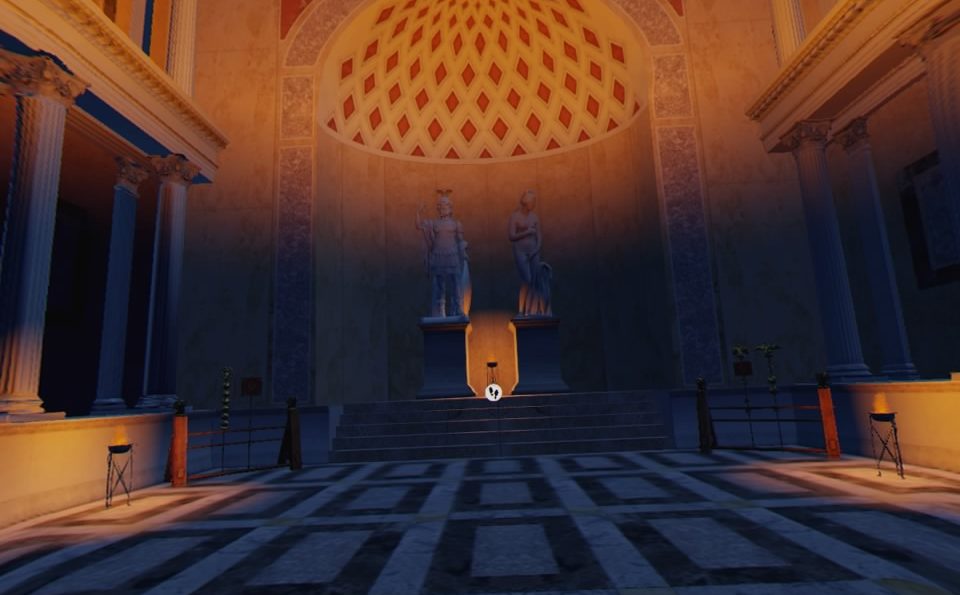
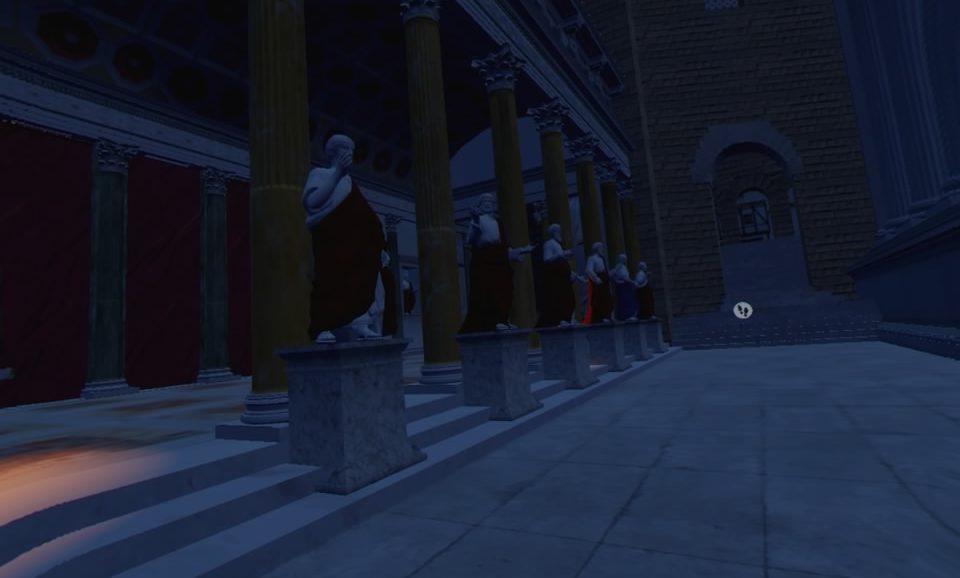
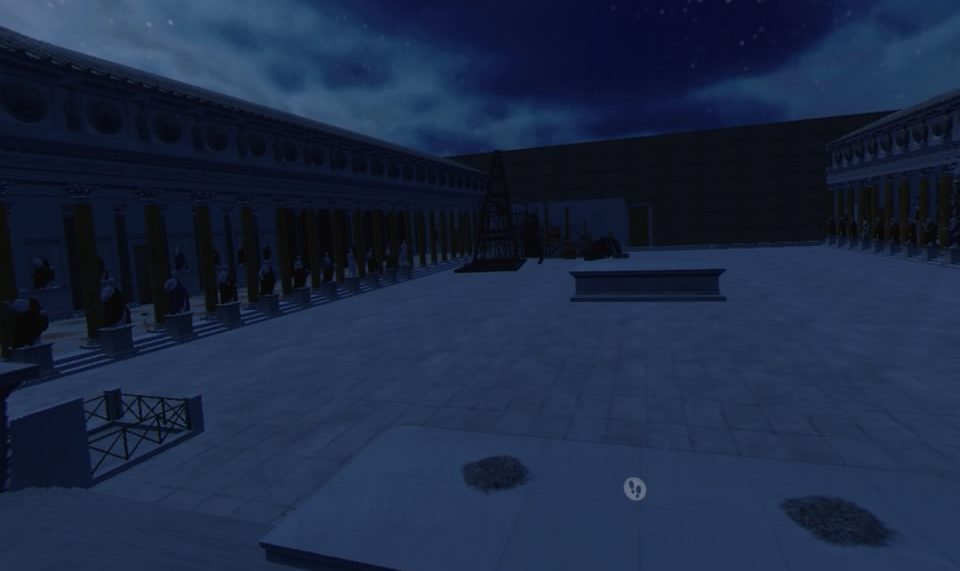
    A Night at the Forum looks okay though it’s clear this was made on a limited budget.  Statues surrounding the forum are recycled many times over though may be in a slightly different position with other textures coming off simplistic at best, and ugly when you get to close.  It’s not all bad as the recreated forum has some smaller halls to visit that pay a little more attention to detail as they contain relics from that age.  Torches light up as you traverse the halls with subdued lighting effects to accompany them but besides that, the entirety of the game is static and rather barren.  The scale of the Forum is still cool to take in and seeing these ruins brought back to life and wandering through them elicits a small sense of wonder.

    There are some neat statues and architecture to check out.

    The audio is probably the shining point as your host, who reveals himself soon enough, details all the event surrounding any item you can interact as he does so with much gravitas.  There is a far bit of dialogue in here with the game kindly asking you to stop what you are doing and listen.  When wandering the courtyard, looping background sounds play, which is fine enough save for a moaning cat which you probably hear once a minute and I’m not really sure why they just didn’t opt for the quiet sounds of the night instead of that annoying animals singular cry.

    My largest issue with this, especially when compared to The Chantry, is that I was just bored throughout the 45-minute experience.  The Chantry opted to tell a story through discoveries whereas The Forum just lists off historical facts in whatever order you discover them in leaving the entire experience feeling a little disjointed.  That’s not to say I didn’t pick up a few tidbits of knowledge, but this experience never really hooked me and the drive to push through and learn more about this time period just wasn’t there.  After play through the main game, you can revisit the forum in ‘Museum mode’ which allows you to explore the area without mission objectives, but there is no new content so it’s really just for those who maybe want to listen to fact you may have missed the first time.

    Statues, statues and more statues!

    All in all, A Night at the Forum does what is sets out to do, but little else.  It doesn’t look awful, but it’s not that good either.  The facts and stories are interesting enough assuming you care about the subject mater.  If you don’t, I don’t think what’s here will grab your attention as its rather dry, leaving this to be much more niche then I think was intended.  If you are curious about Roman history, you’ll probably pull something from this, but for everyone else, this might be a pass.

    What would I pay?  This is roughly $5 which is a perfectly fine ask for this if the subject matter interests you.  If not, you might be better off spending your money elsewhere as there just isn’t that much here.

    VRTRON provided The VR Grid with a press code for this title and, regardless of this review, we thank them for that!